
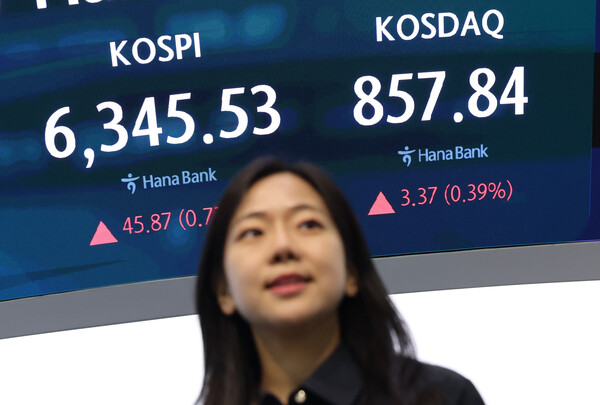
Retail investor funds poured into the Kosdaq, helping it hold above the 850 level. On the KOSPI, retail investors were net sellers, while they bought more than 400 billion won net on the Kosdaq, extending a recent shift in flows toward small and mid-cap stocks.
On Aug. 11, the KOSPI ended up 45.87 points, or 0.73 percent, at 6,345.53. The index opened lower at 6,240.06, down 59.60 points, or 0.95 percent, but quickly turned higher and rose to the 6,400 level. It gave up part of its gains late in the session to close around 6,340.
In the main board market, foreigners and institutions were net buyers of 44.5 billion won and 30.6 billion won, respectively. Retail investors were net sellers of 71.1 billion won.
Among top market-cap stocks, Samsung Electronics closed up 4.13 percent at 239,500 won. SK Hynix also rose 0.35 percent to 1,425,000 won.
Samsung Biologics rose 2.55 percent to 1,609,000 won, and Samsung Life Insurance gained 3.21 percent to 289,500 won. LG Energy Solution fell 3.54 percent, KB Financial Group slid 2.97 percent, and Hyundai Motor slipped 1.23 percent.
The Kosdaq closed up 3.37 points, or 0.39 percent, at 857.84. Retail investors were net buyers of 435.2 billion won. Foreigners and institutions were net sellers of 358.1 billion won and 96.7 billion won, respectively, with retail investors absorbing the supply.
In the Seoul foreign exchange market, the won-dollar exchange rate stood at 1,418.10 won, down 1.40 won from the previous session.
As the Kosdaq's relative strength continues, some analysis suggests flows that had been concentrated in large-cap stocks are spreading to small and mid-cap shares. According to the Korea Exchange, from the low on July 30 through Aug. 10 the Kosdaq rose about 32.5 percent, while the KOSPI gained about 12.6 percent.
The market is increasingly focused on whether leadership in flows is shifting from the KOSPI to the Kosdaq.
Still, some analysis says it is too early to conclude the recent Kosdaq strength is an independent re-rating. Over the same period, the KOSPI 200 Equal Weight Index and KOSPI mid- and small-cap shares also rebounded strongly, indicating that market flows once concentrated in large semiconductor stocks are spreading across non-semiconductors and small and mid-cap stocks.
Han Ji-young (한지영), an analyst at Kiwoom Securities, assessed the recent Kosdaq strength as having a strong character of a rebound after an excessive decline and narrowing of the return gap with the KOSPI.
She added that rather than a full shift into the Kosdaq, a strategy of holding both the KOSPI and Kosdaq, and both semiconductor and non-semiconductor stocks, is appropriate.
 Sangyeop Oh
yub@d-today.co.kr
Sangyeop Oh
yub@d-today.co.kr