
Sales at South Korean small merchants made with cards issued overseas rose 9.6 times over the past 3 and a half years, the data showed. Foreign consumer spending is rising quickly, but it is concentrated in some areas and industries including Seoul, beauty medicine and tourism special zones. The top 1 percent of stores accounted for 66.9 percent of all foreign card sales, showing a clear concentration trend.
Korea Credit Data (KCD) said on Monday that its analysis of foreign-issued card sales at domestic merchants from January 2023 to June 2026 showed the amount of foreign card sales rose about 9.6 times.
The share of foreign-issued cards in small merchants' card sales also increased to 1.2 percent from 0.2 percent over the same period. Foreign card sales tended to rise around the peak spring and autumn seasons for visits to South Korea each year.
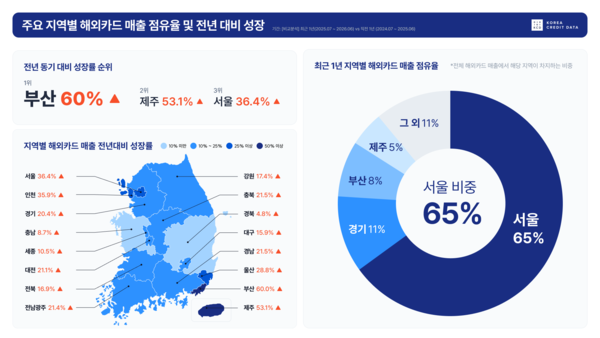
By region, Seoul showed a high concentration. Some 65 percent of nationwide foreign card sales occurred in Seoul, followed by Gyeonggi at 11 percent, Busan at 8 percent and Jeju at 5 percent.
Year-on-year growth was relatively high in Busan at 60.0 percent and Jeju at 53.1 percent. The analysis said foreign tourist spending is expanding to major tourism cities beyond Seoul.
There were also large differences by region and industry. In Seoul, the share of foreign card sales in services was 5.53 percent, higher than Jeju's 1.70 percent and Busan's 0.96 percent. In Jeju and Busan, the share of foreign card sales in the food service industry was 2.43 percent and 1.52 percent, respectively, while the share in distribution was 2.63 percent and 1.25 percent, respectively.
Within services, spending was concentrated in beauty medicine. Of foreign card sales in services, dermatology accounted for 40 percent and plastic surgery for 14 percent.
Average spending per customer also differed between foreigners and South Koreans. In services, foreigners spent an average of 166,000 won per transaction, about 3.5 times the 47,000 won for South Koreans. In health and medical services, the gap widened to about 8 times. In the food service industry, the foreign average ticket was about 1.2 times that of South Koreans, a relatively small difference.
By commercial district, Seoul's Myeongdong-Namdaemun and Sinnonhyeon-Gangnam Station ranked among the top areas for foreign card sales. Monthly average foreign card sales per business in tourism special zones was 3,483,000 won, and foreign-issued cards accounted for 13.9 percent of total sales. The share of foreign card sales in alley commercial districts and traditional markets was about 1.4 to 2.5 percent.
Sales concentration by store was even higher. The top 1 percent of stores by foreign card sales accounted for 66.9 percent of total foreign card sales, and the top 10 percent accounted for 90 percent. The remaining bottom 90 percent of merchants accounted for just 10 percent.
Kang Ye-won (강예원), data chief at Korea Credit Data, said, "Foreign card payments have risen more than ninefold in three years, but they are still concentrated in some areas such as Seoul and beauty medicine, tourism special zones and large franchise retailers." Kang said, "It has not spread sufficiently to most small merchants."
Kang added, "Policy attention is needed to support adoption of store operation solutions and payment infrastructure so that the benefits of increased foreign spending in South Korea can reach neighborhood commercial districts and small stores."
 Ji-young Lee
ljy@d-today.co.kr
Ji-young Lee
ljy@d-today.co.kr