
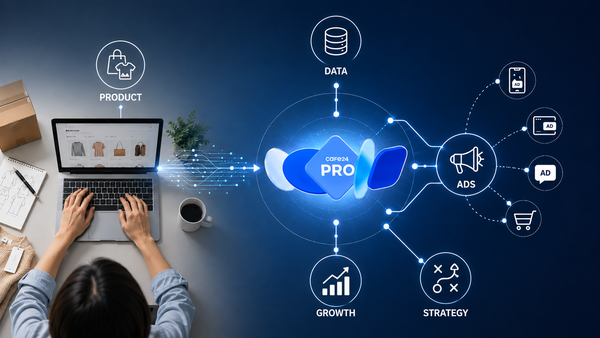
The basic structure in which online shopping mall owners handle everything from product planning to ad operations themselves is hitting its limits. Advertising is shifting beyond creative production and budget spending into ongoing operations that keep adjusting products, channels and creatives based on data. Cafe24 aims to ease that burden with "Cafe24 PRO Marketing," in which professional marketers take charge of the entire ad-operations process.
Most online shopping malls have a single owner handling product planning and sourcing, customer service and delivery. Adding ad operations creates a structure in which the owner must manage both brand growth and day-to-day work. The ability to make products and the ability to promote them are different in nature, yet both are required of one person.
The burden is also confirmed in survey data. In a small business survey commissioned by the Korea Enterprises Federation from Monoresearch, 39.2% of online sellers cited difficulties in marketing and promotion as a major management challenge. It means that while the importance of communicating to the market has grown, marketing remains a key task for small brands that struggle to secure dedicated staff.
The changing nature of advertising work also adds to the burden. Advertising does not end with making creatives and executing a budget. Decisions must be made and adjusted continuously based on data, including which products to advertise first, which channels should receive more budget and when to replace underperforming creatives. As the number of products and ad channels increases, so does the number of items that require judgment.
That is why larger companies are more likely to have dedicated organisations for ad operations. Most online shopping malls, by contrast, find it hard to build such operational capabilities internally. In a structure where an owner juggles hands-on work, ad checks can easily be pushed behind other tasks, and budgets can continue to be spent on ads whose performance has already weakened.
PRO Marketing introduced by Cafe24's marketing centre targets that gap. Professional marketers manage the entire process from ad planning and creative production to media operations and performance analysis. The company says business owners can reallocate time spent on ad operations to products and brands.
Cafe24 cited its data linkage as the difference from ad agencies. It says it analyses product, sales and ad performance data accumulated in a shopping mall together and reflects the results back into ad strategy. Going beyond reviewing ad metrics alone, it analyses which products sell steadily, which have greater growth potential and which creatives lead to actual purchases, applying different strategies for each mall. For malls short on ad creatives, it starts with creative production, while for malls without clear key products, it resets ad priorities based on product data.
◆Advertising shifts from execution task to always-on decision-making
According to Cafe24, performance differences stood out among brands that had struggled with ad operations. "Vivid Via," a children's parallel-import apparel brand, had little advertising experience. The owner ran Meta ads directly but could not track results, then introduced PRO Marketing and redesigned the ad structure based on product data. As a result, it recorded a return on ad spend (ROAS) of 818 percent in 25 days.
"Closet Nine," a women's apparel brand, chose to focus internal capabilities on product planning and sourcing rather than handling marketing directly with limited staff. Within 84 days of adoption, mall sales rose 227.2 percent, the number of ad purchases increased about fourfold and ROAS reached 977 percent. Closet Nine CEO Minju Kim (김민주) said, "By partnering with a marketing specialist at an affordable cost, we can now focus only on product planning and sourcing." "Sunguard Optical Mall," which has made polarised products for more than 20 years, had also hit limits in running ads in-house. After adopting PRO Marketing, sales rose 113.8 percent, new visitors increased 119.2 percent and ROAS reached 527.6 percent.
Cafe24 said the cases share a common point in that the changes came after altering ad-operations methods. It said they should be distinguished from results driven by increasing ad budgets. However, detailed conditions such as ad spending levels and comparison timing were not disclosed, limiting simple comparisons across brands.
The three brands differed in advertising experience, industry and operating conditions. Their starting points varied, including those starting advertising for the first time, those lacking time to operate ads and those that felt limits in running ads directly. Cafe24 said they shared the point that performance improved after entrusting ad operations to an external specialist organisation and data system.
Ad operations are becoming a specialist area in which judgment and optimisation are repeated based on data. The approach that large companies have carried out through dedicated organisations is spreading to small online shopping malls. Still, the cases presented reflect short-term early results after adoption, and effects may vary depending on industry, product mix and the existing level of ad operations. It remains to be confirmed whether performance is sustained over the long term and whether it appears in the same direction for sellers of various sizes.
In response, Cafe24 presented PRO Marketing's aim as a structure in which business owners focus on products and brands while advertising is run through data and external expertise. In shopping mall operations, how work is divided between what owners do themselves and what they allocate externally is being treated as a variable that determines growth speed.
 Dae-geon Seok
d2dg@d-today.co.kr
Dae-geon Seok
d2dg@d-today.co.kr