
The government is speeding up the mega project. It presented a total of 353 trillion won in investment plans set to begin this year through construction starts or facility expansions, including 246 trillion won in the Chungcheong region and 107 trillion won in the Yeongnam region. About 40 days after the mega project announcement on June 29, the timing for relocating the Gwangju military airport and schedules for power and water supply were also released, settling many variables related to sites and infrastructure.
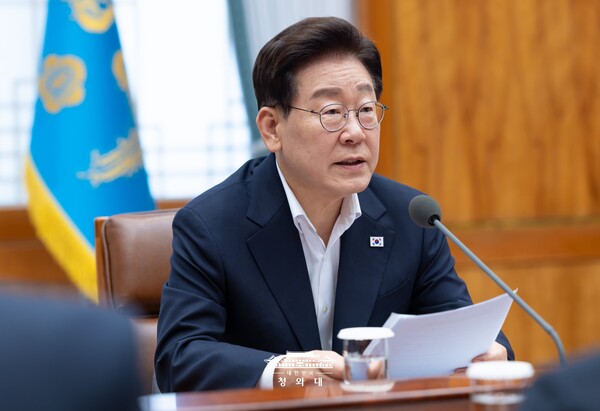
President Lee Jae-myung (이재명) said at the second public-private joint inspection meeting on the mega project held at Cheong Wa Dae on Sunday that related procedures should be pursued simultaneously to sharply cut the time required and that regulations should be continuously improved. "We have to go beyond a speed campaign and wage a blitz," he said. Lee also instructed the Ministry of National Defense to temporarily relocate Gwangju base functions to other military airports by mid-2028 so the site can be used early as a semiconductor industrial complex.
A post-meeting briefing by presidential chief of staff Kang Hoon-sik (강훈식) said six companies in the Chungcheong region, including SK Hynix and Samsung Electronics, Samsung Electro-Mechanics, Samsung Display, Samsung SDI and Naver, will start projects worth 246 trillion won this year. That means much of the 392 trillion won investment plan by eight companies presented at the Chungcheong region public report meeting in early July moves into the execution stage within the year.
In the Yeongnam region, eight companies including SK, Samsung Electronics, Samsung SDS, LG Innotek, LG Display, Hanwha, Hyundai Motor and Doosan will begin projects worth 107 trillion won. It is part of the 312 trillion won plan by 12 companies presented at the Yeongnam region public report meeting. A 57 trillion won research and development project will also begin within the year.
The schedule to prepare the site for a semiconductor cluster in the Honam region has been specified. The government decided to complete the relocation and temporary dispersal of military facilities by the second half of 2028 for the 2.5 million pyeong Gwangju military airport site that was designated as a candidate for a national industrial complex at the first meeting. Kang said the planned ammunition depot site will be prepared in advance by starting site development work early so companies can begin fab construction as early as possible if they want. The government will also review a plan to designate nearby land as additional candidate sites after confirming corporate demand.
Electricity will be supplied from the end of 2028 after building a first-phase supply line. Local renewable energy, energy storage systems and combined heat and power and liquefied natural gas generation will be used together. Water supply will secure 650,000 tonnes a day by 2030 through recycled wastewater and the Dongbok, Juam and Naju dams. For the Yongin semiconductor cluster, the plan is to meet final power demand of 14.7 GW by 2041 by combining combined heat and power and LNG within the industrial complex with generating capacity from the Jungbu, East Coast and Honam regions.
The plan to purchase 700 humanoids is "insufficient"; order given to expand robot purchases.
The government will also accelerate the spread of physical AI. At the meeting, Industry Minister Kim Jeong-gwan (김정관) reported that the government will buy 700 humanoids for research and data factory use by 2030 and more than 1,000 other robots such as quadruped robots to create an initial market. Lee said this was not enough to create a physical AI market and instructed that the scale of government purchases be expanded based on a demand survey. The government will also establish dedicated R&D for key components such as actuators, sensors and robot hands for small and medium-sized robot parts companies, and build a robot foundry in Saemangeum.
Support measures for materials, parts and equipment and small and medium-sized firms were also announced. In semiconductors, a "together growth project" in which large and small firms cooperate from technology development through demonstration and mass production will be 추진 over the next 10 years at 1 trillion won. The government will also create 5 trillion won in win-win trade finance to ease funding difficulties for exporters of materials, parts and equipment, and a new 5 trillion won fund to invest in promising materials, parts and equipment companies and fabless firms. It will also support expanding the signing of price-linking agreements between large and small firms so cost fluctuations are reflected in delivery prices.
Tax support has already taken shape. The 2026 tax revision plan announced on Aug. 3 included a domestic production tax credit for the first time. It targets six areas, including solar and wind power generation, secondary batteries, semiconductors, key materials and AI robot parts, which largely overlap with the industries targeted by the mega project. If a domestic resident meets the requirement of directly producing and selling in South Korea, the deduction amount is determined based on output and a base deduction amount, and the credit applies through Dec. 31, 2036.
Incentives for regional investment were also included. A production area coefficient will be introduced, applying 1.0 for the Seoul metropolitan area, 1.1 for non-metropolitan major cities and other areas, 1.3 for other non-metropolitan areas, and 1.5 for other non-metropolitan preferred areas. For the last three years of the deduction period, however, the deduction amount will be reduced to 75 percent, 50 percent and 25 percent, and overlapping application with the integrated investment tax credit will be excluded. The Ministry of Trade, Industry and Energy and the Ministry of Economy and Finance plan to consult industry associations and groups during National Assembly discussions and preparations of follow-up regulations to specify eligible items and application requirements.
A special law on mega special zones to shorten permitting and environmental impact assessment periods will be pursued for enactment within the year. A dedicated organisation for the mega project will be established at Cheong Wa Dae, and a pan-government support consultative body will be set up under the Prime Minister's Office. A separate issue, easing the 52-hour workweek system through a special provision, was postponed. Kang said he judged the success of the mega project was not directly related to the 52-hour workweek system and that it is possible only when the relevant region and labour circles discuss it together and agree. The two main labour federations issued a position on Aug. 3 condemning the 추진 of the mega special zone law. Lee asked those attending the meeting, including Samsung Electronics President Kim Yong-gwan (김용관) and SK future growth head Jeong Seung-il (정승일), to continue to take special interest.
 Dae-geon Seok
d2dg@d-today.co.kr
Dae-geon Seok
d2dg@d-today.co.kr