
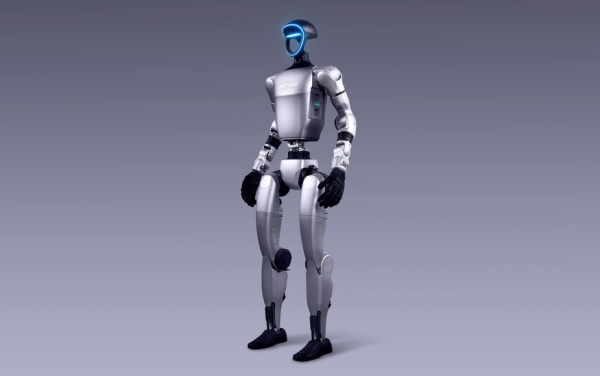
[DigitalToday reporter Jinju Hong] Chinese robot company Unitree said it can continue selling six existing flagship robot models in the U.S. market despite new U.S. restrictions on Chinese technology. It said it had already secured equipment certification for major products before the U.S. Federal Communications Commission tightened its rules.
On Aug. 7 local time, blockchain outlet Cryptopolitan reported that Unitree had obtained equipment approvals for major humanoid and quadruped robots before the FCC’s new rules took effect.
Pupenghua (푸펑화), board secretary at Unitree, said at an online investor briefing held ahead of a Shanghai stock market listing that humanoid robots G1, H2 and R1 and quadruped robots Go2, B2 and A2 all received FCC equipment approvals before the rules entered into force.
Categories newly added to the FCC’s regulatory scope include robots weighing more than 2 kg with mobility and communication functions, and devices with their own sensors and a certain level of autonomy. Unitree’s main humanoid products could also fall into the category, but it said products that have already obtained certification can continue to be sold in the U.S. market for the time being.
The move came as the FCC expanded its Covered List, which it has operated on national security grounds. The FCC added foreign-made advanced robotic equipment and power inverters used in solar installations to the list. As a result, new products that fall under the new rules could face limits on entry into the U.S. market.
Unitree also stressed in a recent IPO prospectus that its core products are not directly affected by the latest regulations. It effectively highlighted to investors that regulatory risks for U.S. sales have been eased to some extent ahead of a listing on Shanghai’s STAR Market.
Unitree applied for an initial public offering of about $610 million in March. It then held preliminary pricing discussions on Aug. 5 and was set to begin subscriptions from Aug. 10. It originally planned to raise about 4.2 billion yuan to invest in robot research and development, hardware development and building new production bases, but as investor demand proved stronger than expected, the actual offering size expanded to about 6.1 billion yuan, or $898.4 million.
Still, the certifications do not remove all regulatory uncertainty for Unitree’s U.S. business. Unitree separately said new products developed after the regulatory cutoff could face restrictions in entering the U.S. market. It said specific exemptions or conditional approvals may be needed for new models to be sold in the United States. Models that fail to meet the latest rules are expected to be allowed in only if the U.S. Department of Defense grants conditional approval.
Overseas markets account for an important share of Unitree’s performance. The company said overseas revenue accounted for more than 40% of total revenue over the most recent three reporting periods. Reliance on U.S. revenue is declining. The U.S. share of revenue was 13.30% in the most recent reporting period, down from 18.39% and 19.54%. Unitree claims it ranked No. 1 globally in humanoid robot shipments in 2025.
U.S. restrictions on Chinese technology are expanding beyond the robot industry to other advanced technology fields. The FCC is also considering measures to limit supplies of Chinese optical transceivers to U.S. data centres, and U.S. authorities are also investigating whether China accessed Nvidia artificial intelligence chips through overseas channels.
The Chinese government pushed back against the U.S. measures. China’s Commerce Ministry argued that the FCC rules use neutral wording but in practice discriminate against Chinese companies, and called for them to be withdrawn. It also warned it could take countermeasures if the United States presses ahead.
Unitree has ultimately kept a channel open for U.S. sales of existing products for the time being, but it may face new barriers when launching new products. Given the U.S. share of its overseas revenue and the continued expansion of U.S. restrictions on Chinese technology, Unitree’s U.S. business is expected to face a situation in which the regulatory environment clearly diverges between existing products and new models.
 Jinju Hong
hongjj@d-today.co.kr
Jinju Hong
hongjj@d-today.co.kr