
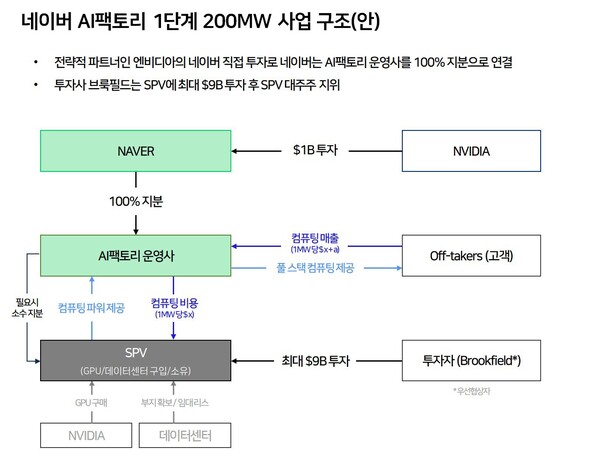
Naver is pushing a plan to secure computing infrastructure for building an artificial intelligence (AI) factory by receiving graphics processing units (GPUs) from Nvidia and using a separate investment structure under discussion with Brookfield Asset Management. It aims to spread initial investment and borrowing burdens by avoiding a structure in which Naver buys all GPUs and data centre facilities itself.
A Naver disclosure dated Aug. 3 showed the AI factory project is being discussed in a format under which Naver handles operations, Nvidia supplies GPUs and Brookfield participates in raising funds to build large-scale computing infrastructure.
The project initially targets a 200 megawatt first-phase business to be pursued through 2028, part of Naver's plan announced in June to build a final 1 gigawatt-class AI factory.
The buildout goal is to expand from 55 MW in the first half of 2027 to a cumulative 100 MW by the end of that year and a cumulative 200 MW in 2028. It plans to ultimately build gigawatt-class infrastructure. The first base will be Naver's hyperscale data centre, Gak Sejong, and it plans to expand business regions beyond Asia-Pacific to Europe and the Middle East.
Nvidia to supply GPUs; talks with Brookfield on infrastructure investment
Naver specified Nvidia's role through a revised disclosure on July 27. In a June 8 filing, it explained Nvidia would participate as a business entity that, in addition to supplying GPUs, would help find global customers and jointly bear revenue and business risks. In the revised disclosure, that wording was removed and Nvidia was specified as the entity supplying GPUs.
Nvidia also plans to participate in Naver's third-party allotted paid-in capital increase worth about $1 billion, or about 1.4 trillion won. Naver plans to form an equity relationship with Nvidia to secure the latest GPUs needed to build the AI factory on a stable basis and expand opportunities for future business cooperation. With AI data centre investment growing and competition intensifying to secure advanced GPUs, it aims to bring in Nvidia as a shareholder to establish a supply base. The structure also allows Nvidia to expand its GPU ecosystem through Naver's expansion of its AI computing business.
Funding needed to build GPUs and data centre facilities is being discussed as a plan to be raised by Brookfield. According to the Naver disclosure, the scale of computing infrastructure needed to build the AI factory through 2028 is $9 billion, or about 12.6 trillion won. A plan has been proposed under which Brookfield raises funds through project financing to form a special purpose vehicle (SPV), with the SPV buying and owning GPUs and data centre facilities. Naver is holding talks to sign a contract to use those assets. Naver will place the AI factory operator as a wholly owned subsidiary and oversee the AI computing business.
Naver's operator would use computing resources held by the SPV, pay costs based on usage and generate revenue by selling them to outside companies and institutions. It is a structure under which Naver uses needed computing resources and pays fees instead of buying all GPUs and data centre facilities with its own funds. This can reduce large-scale facility investment and direct borrowing burdens in the early stages of the project. Actual accounting treatment and the costs Naver bears may vary depending on contract terms, control of assets and minimum usage obligations.
Naver is also considering acquiring a minority stake in the SPV formed by Brookfield to secure computing resources on a stable basis. A contract with Brookfield has not been finalised. Naver plans to select Brookfield as an exclusive preferred bidder for 12 weeks and hold talks to sign a formal contract.
The $9 billion presented in the disclosure is not an amount Naver invests directly, but the proposed scale of computing infrastructure to be assembled by Brookfield. The amount of investment Naver will directly bear has not yet been decided. A detailed schedule and phased investment scale may also change depending on market conditions and the outcome of talks.
Winning external customers is key; site and permits among variables
Naver plans for the AI factory operator to secure new revenue sources by selling computing resources it has secured to outside companies and institutions. The current material, however, does not present specific external customers or the size of supply contracts.
Uncertainty in the regulatory environment such as securing local data centre sites and obtaining permits in each country, delays in securing power infrastructure and possible swings in global AI infrastructure supply and demand, as well as possible changes in terms or schedule delays during detailed contract talks, are cited as factors that could affect future schedules and investment scale. Naver's policy is to adjust the phased schedule and investment scale in response if such factors arise.
Naver plans to separately disclose relevant details under related laws and disclosure rules if individual contracts are finalised and meet or exceed the disclosure threshold amount.
 Ho-jung Lee
lhj@d-today.co.kr
Ho-jung Lee
lhj@d-today.co.kr