
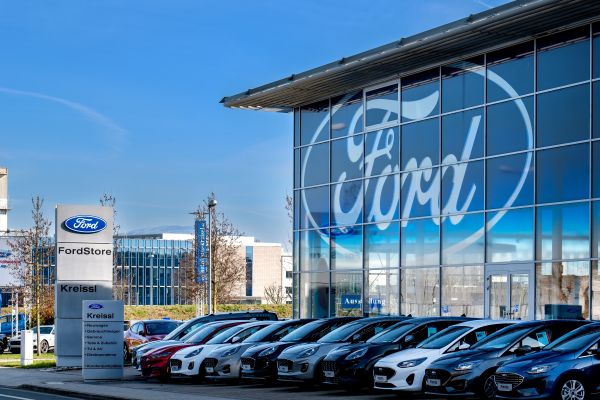
Ford expects Chinese electric vehicle brands to enter the U.S. market within 5 to 10 years and has begun preparing a response.
InsideEVs, an electric-vehicle outlet, reported on July 31 that Ford CEO Jim Farley (짐 팔리) and other executives told employees this week they believe Chinese EVs will enter the U.S. market within the next 10 years.
Ford did not rule out Chinese companies entering the United States despite trade barriers, a ban on Chinese vehicle technology and related legislative efforts in the U.S. Senate. Executives put the entry window at 5 to 10 years and said it is likely to come in the latter part of that range. A Ford spokesperson declined to comment on the closed-door employee meeting.
Farley has been seen as one of the U.S. automakers' executives who has issued the strongest warnings about the spread of Chinese EVs. He has said the United States should not allow Chinese EVs to enter the country. A specific timetable, however, is new.
Barriers to entry in the United States remain high. A ban on Chinese vehicle technology finalised late in the Biden administration pushed Polestar out of the U.S. market. Congress is also pursuing legislation targeting automakers with more than a 15 percent Chinese ownership stake. That regulatory environment remains a key factor blocking a direct move by Chinese companies.
Even so, Ford is not downplaying the threat because Chinese companies are developing vehicles quickly. China's auto industry has cut vehicle development cycles to as little as 18 months, a wide gap with the 5 to 7 years typical for Western companies. That speed is also fuelling market overheating in China. The emergence of 650 new EV models in China this year alone shows supply competition has already become extreme.
Conditions in the North American market are also a variable. Chinese EVs can be sold in Canada and Mexico, and consumer interest in low-priced battery EVs has grown in recent months. Even if U.S. mainland rules remain in place, it is possible to interpret Ford as taking into account that Chinese brands could expand their influence via nearby markets. Ford, however, appears to be preparing internally on the assumption of direct entry into the U.S. market.
Ford's response is a new EV platform. To take on EV startups and Chinese companies, Ford is preparing a newly designed "universal EV platform" built from the ground up. The first model on the platform will be a midsize pickup and is due to go on sale in 2027.
Against that backdrop, the focus of North American EV competition appears to be shifting beyond simple tariffs or import curbs to development speed, price competitiveness and platform efficiency. As Ford views Chinese EV entry into the United States as a matter of time and lays out a specific response schedule, attention has also turned to the direction of U.S. regulation and a reshaping of the North American market.
 Jinju Hong
hongjj@d-today.co.kr
Jinju Hong
hongjj@d-today.co.kr