
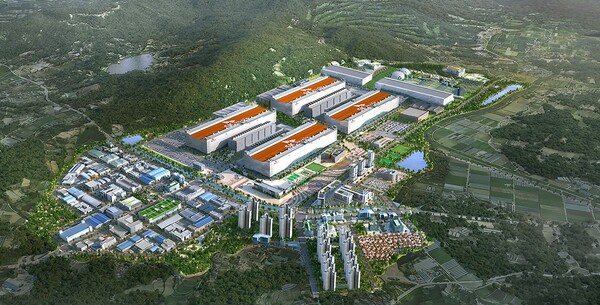
The pace of bringing forward groundbreaking dates for semiconductor fabs is outstripping power grid and water supply schedules. Samsung Electronics has set 2029, 1 to 2 years earlier than previously expected, as the target to start operating the first production plant (fab) at the Yongin national industrial complex in Gyeonggi province. SK Hynix will open the cleanroom for the first fab at the Yongin general industrial complex in early 2027. By contrast, the government’s final power supply date for the national industrial complex, presented after cutting 11 years, is 2042. As of 2024, power flowing into Yongin is 1.9 gigawatts, about one-eighth of final demand. The structure remains in which fabs come first and the power grid follows.
According to the industry, Samsung Electronics has set 2029 as the start-up date for the first of six fabs to be built at the Yongin national industrial complex and is proceeding with follow-up steps. To meet that schedule, it must break ground by 2027 at the latest. Kim Jae-joon (김재준), head of strategic marketing at Samsung Electronics’ memory business division and a vice president, said on a second-quarter conference call on the 30th that given a lead time of more than 3.5 years from new fab construction to wafer production, it will be difficult to expect a sharp increase in supply through 2028 even as industry capital expenditure expands.
It also projected that the supply shortfall in 2027 will deepen from this year and continue in 2028. It said it will apply more strongly an approach of securing sites and cleanrooms first and then installing equipment in line with changes in demand. Of Samsung Electronics’ 16.8 trillion won in second-quarter facilities investment, 15.4 trillion won was spent in the semiconductor (DS) division, and infrastructure investment for new fabs in Pyeongtaek expanded.
SK Hynix said on a conference call on the 29th that it expects this year’s investment to be in the high 40 trillion won range. It said it will bring forward the mass production schedule for M15X and rapidly expand production capacity after opening the cleanroom for its first Yongin fab. U.S. company Micron also has a plan to increase its U.S. investment to $250 billion (about 375 trillion won) by 2035 and have the United States account for 40 percent of total DRAM production.
Samsung Electronics has completed long-term supply agreements (LTAs) with five major global data center customers using a rolling structure that starts with five years and adds one year each year. It set a target of filling 60 to 70 percent of planned capacity with such contracts. SK Hynix also completed LTA negotiations with about 10 customers, including key clients. With demand tied up in contracts, the remaining variable narrows to whether factories to produce those volumes can be built on time.
The government said on the 22nd it would bring forward the final power supply date for the Yongin national industrial complex by 11 years to 2042 from 2053. It also said it would shorten phase-one supply of integrated water to May 2029 from 2031, cutting 20 months. Power supply will be 추진 in three phases: an LNG power plant within the industrial complex and reinforcement of nearby transmission lines through 2030; expansion of existing transmission grid capacity through 2036; and construction of a linked system connecting generating capacity in the Yeongdong and central regions through 2042.
Even with the shortened plan, a gap remains. According to the National Assembly Research Service, as of 2024 the power being supplied to Yongin is about 1.9 gigawatts. That is about one-eighth of the roughly 15 to 16 gigawatts needed for full operation of the cluster, including 9.3 gigawatts for the national industrial complex and 5.5 gigawatts for the general industrial complex. With the schedule showing 3 gigawatts from phase-one LNG generation coming in early 2030, power in the period covering 2027, when SK Hynix’s Fab 1 runs, and 2029, Samsung Electronics’ target for its first fab, must rely on reinforcement of the existing system.
The report’s analysis said the water shortfall, excluding the portion secured for the general industrial complex, will grow to 414,000 cubic metres a day in 2035 and 1,097,000 cubic metres a day in 2050. It said surplus capacity in multipurpose dams in the Han River system stands at only 80,000 cubic metres a day as of 2035. Water for power generation at Hwacheon Dam, to be brought in as part of phase two, still lacks a legal basis for non-purpose use, and issues over allocation of river water usage fees between Gangwon province and Gyeonggi province have not been settled.
Semiconductor stocks swing on minor news
With variables that shape supply 전망, such as fab start-up timing and infrastructure schedules, not yet settled, swings in the share prices of leading semiconductor stocks are also growing. On the 31st, the KOSPI ended at 6,595.45, up 17.91 percent from the previous day. Samsung Electronics closed up more than 26 percent at 262,500 won and SK Hynix finished up nearly 30 percent at 1,718,000 won, lifting the index.
It follows a move in which the index, which had been pushed down to the low 5,000s after circuit breakers for two consecutive days, traced a swing of more than 1,300 points in three days. It was as if large-scale selling and buying alternated day by day in the same stocks, and was read as meaning the market is unable to find direction over supply schedules.
According to the Financial Times, the ratio of daily volatility of the Philadelphia Semiconductor Index compared with the S&P 500 index was recently 4.9 times, exceeding the 4.2 times recorded just after the 2000 dot-com bubble burst. FT analysed that semiconductor stock valuations have expanded excessively, so share prices may overreact even to minor news, and large-scale buying or selling could emerge even with small changes in earnings and demand outlooks.
Site first, infrastructure later...Research service proposes procedural overhaul
For now, easing administrative procedures is the top priority. The timing of groundbreaking for the Yongin cluster will be set by how quickly land compensation, permits and licensing, and consultations on transmission lines are concluded. According to the research service, the national industrial complex schedule is to change the industrial complex plan and go through compensation procedures in the first half of this year, start land development construction in the second half, and complete it in the second half of 2031.
If the start-up date is brought forward, the timing of spending execution is also expected to move up. The total project cost for transmission lines and construction of substations within the industrial complex is 2.4 trillion won based on the research service’s data, of which the private sector share is about 1.7 trillion won. For the 2.2143 trillion won integrated water supply project, Korea Water Resources Corp will bear 66.9 percent, Korea Land and Housing Corp (LH) and Samsung Electronics 22.2 percent, and SK Hynix 10.9 percent.
Ultimately, whether groundbreaking occurs in 2027 depends on the pace of follow-up procedures, such as land compensation and expropriation rulings. The transmission line route map also remains a variable. In places such as Anseong, through which many lines pass, complaints have been raised that they provide only routes without any special benefit. The research service said a method of selecting sites first and matching infrastructure later increases the risk of construction delays, and proposed a procedural overhaul to first calculate available infrastructure supply and then decide the industrial complex scale and industry types.
 Dae-geon Seok
d2dg@d-today.co.kr
Dae-geon Seok
d2dg@d-today.co.kr