
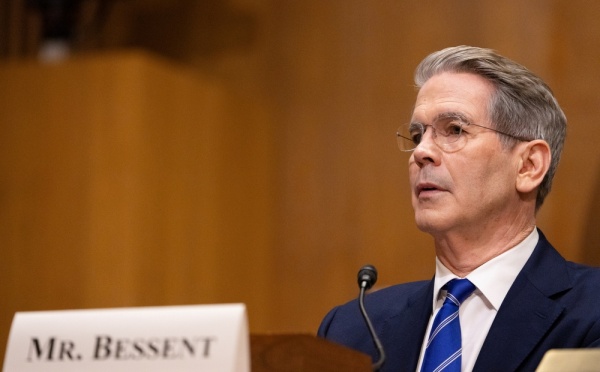
[DigitalToday reporter Yoonseo Lee] U.S. Treasury Secretary Scott Bessent urged the Senate to hold an immediate vote on the Clarity Act, a digital asset market structure bill.
On July 30, blockchain media outlet Decrypt reported that Bessent said Democrats are delaying the vote for political reasons. He argued that without clear rules, the United States could lose leadership in digital assets.
In a lengthy post on X, formerly Twitter, Bessent said the House passed the bill more than a year ago. He said staff from the Senate Banking Committee and the Senate Agriculture Committee then spent thousands of hours negotiating bipartisan amendments. He said Republicans have now prepared a bill that is ready for a floor vote.
The key issues are regulatory clarity and the supervisory framework. The Clarity Act would establish a federal framework for the U.S. digital asset market. If enacted, it could bring most cryptocurrency activity in the United States into the regulated system. Oversight would be split between the U.S. Securities and Exchange Commission and the U.S. Commodity Futures Trading Commission, with most crypto assets falling under the CFTC.
He also directly rebutted Democrats’ core arguments on consumer protection and blocking illicit funds. He said Parts 2 and 3 of the bill would significantly expand compliance obligations for digital asset intermediaries and make them closer to the level applied to existing financial institutions. He said claims that the bill lacks consumer safeguards and anti-illicit finance tools are not true.
He also defended a provision in the bill called the Blockchain Regulatory Clarity Act, or BRCA. The provision would codify existing Treasury policy that exempts decentralized software developers from registration requirements under the Bank Secrecy Act. Bessent said the Fraternal Order of Police, which had opposed the measure in the past, has now shifted to support it.
He also raised the level of political attack. He criticized Democrats for worrying about backlash from Senator Elizabeth Warren and what he called an “anti-crypto army.” He wrote, “With a major win for American leadership ahead, Senate Democrats are choosing politics,” and added, “Look through history for instances where Congress decided to push an industry out of the United States instead of regulating it smartly.”
At the end of the post, he also cited a line by bitcoin creator Satoshi Nakamoto. Bessent wrote, “It’s either America leads, or loses its place,” adding, “It’s exactly the same as Satoshi’s words: ‘If you don’t believe me or don’t get it, I don’t have time to try to convince you, sorry.’”
The Clarity Act is considered one of the crypto industry’s top legislative priorities in Washington. Recent discussions, however, have been blocked by ethics provisions. Senate Republicans included language in an amendment released in May that would bar the president and other federal officials from issuing or sponsoring digital assets while in office. According to recently disclosed materials, U.S. President Donald Trump made more than $1.2 billion from crypto businesses in 2025 alone, and the provision was seen as targeting such business activity.
Democrats are raising issues including that the restriction expires in 2029, that enforcement authority rests only with the Justice Department, and that it does not apply to officials’ children. The path for the bill therefore remains uncertain. Senate Republican Leader John Thune has also said recently that he does not expect Senate passage before the August recess because negotiations over the ethics provisions are not finished.
In this situation, the August recess is being discussed as a de facto deadline for legislation this year. After that, Congress is likely to shift its focus to the midterm elections, and whether the Clarity Act can clear the Senate in this session is expected to be a turning point for the direction of U.S. digital asset regulation.
More than a year ago, the House passed the Clarity Act. There’s been progress since — thousands of hours of bipartisan negotiations took place at the staff and Member levels. The Senate Committees on Banking and Agriculture advanced their respective titles. And Senate…
 Yoonseo Lee
yslee@d-today.co.kr
Yoonseo Lee
yslee@d-today.co.kr