
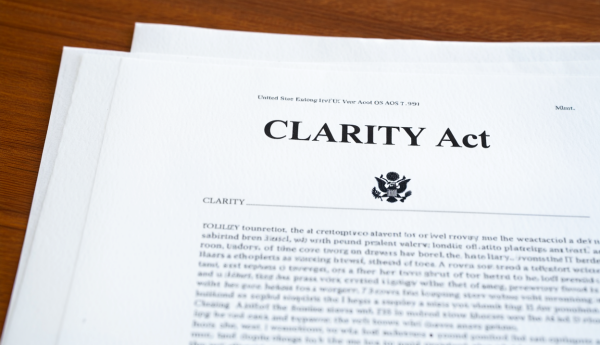
Talks on the U.S. Senate’s digital asset regulation bill known as the Clarity bill are facing late hurdles. An amendment over a provision to protect cryptocurrency software developers has drawn pushback from both the White House and the industry, sending talks on key issues back to square one.
On July 30, blockchain outlet CryptoSlate reported that Democrats have offered some compromises on regulator appointments and ethics provisions. But differences remain among the parties, the White House and the industry over the key issue of the scope of developer liability.
One track of the talks concerns vacancies at the U.S. Securities and Exchange Commission and the Commodity Futures Trading Commission. Senate Democratic Leader Chuck Schumer sent the White House lists of Democratic candidates for commissioner seats at the SEC and the CFTC, respectively. Democrats have argued that prolonged vacancies at financial regulators are weakening the bipartisan operating structure intended by Congress.
The Clarity bill aims to create a new federal regulatory framework for digital asset markets and significantly expand enforcement authority for the SEC and the CFTC. Democrats say it is not appropriate for agencies gaining expanded authority to write rules without minority-party commissioners, but the White House did not view it as substantive progress in talks. Patrick Witt, executive director of the White House President’s Council of Advisers on Digital Assets, criticized Democrats’ proposal, calling it "the bare minimum response to avoid responsibility for sinking the bill" and adding, "No one is fooled."
The biggest issue is the scope of legal liability for cryptocurrency software developers. Two prosecutors’ groups presented amendments this week to the developer protection provision, but the controversy has only grown.
The question is whether developers who simply build software can be treated as financial intermediaries. Senator Catherine Cortez Masto has maintained that law enforcement authorities needed to track illicit funds, recover victims’ assets and prosecute those who transmit criminal proceeds must be preserved. She has also stressed that ordinary developers who do not directly control customer assets or transactions should not be subject to excessive regulation.
The amendment satisfied neither side. The White House said it was hard to see it as progress in talks, and Witt said claims that it was the result of productive talks between the White House and the Treasury Department were "not true." He added the proposal falls far short of what they demanded.
The industry response was also cold. Amanda Tuminelli (어맨다 투미넬리), chief executive of the DeFi Education Fund, criticized the amendment as moving toward treating all software developers like financial intermediaries, regardless of developers’ actual roles or the technical structure. "It is not a constructive or serious proposal," she said. "The industry spent countless hours to address concerns and refine the bill’s language, but what came back was only a proposal that was effectively scrapped."
Ultimately, the core of the talks is to find a balance that preserves law enforcement authority to respond to illicit finance while not imposing intermediary-level obligations on developers who do not control customer assets or transactions. Negotiators are now in a situation where they must revise the language again.
By contrast, talks over ethics provisions are showing relatively more progress. Democratic Senator Ruben Gallego and Republican Senator Thom Tillis plan to draft a bipartisan amendment to submit to the White House within days.
Democratic negotiators say they will continue talks while maintaining their position that ethics rules and safeguards related to consumer protection, prevention of illicit finance, prevention of conflicts of interest and market integrity should be strengthened. The market is watching whether a compromise over the ethics provisions can draw additional concessions from the White House and become a breakthrough for an overall Clarity bill deal.
 Jinju Hong
hongjj@d-today.co.kr
Jinju Hong
hongjj@d-today.co.kr