
A claim has emerged that regulations on channel transactions, premised on cable television operators (SO) being the dominant businesses, do not fit changed market realities.
The analysis says that even if some large multi-programme providers (MPP) demand bundled contracts by leveraging popular channels, SOs find it difficult to end contracts by selecting only unwanted channels, meaning the existing ban on bundling is not working properly.
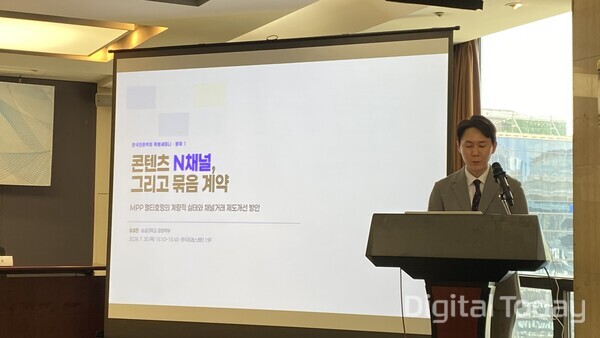
Sung-jin Yoo (유성진), a professor in the School of Business Administration at Soongsil University, said at a special seminar titled "Preparing measures to improve the pay-TV channel transaction market" hosted by the Korean Association for Journalism & Communication Studies at the Korea Press Center in central Seoul on Wednesday that "there are norms, but they are not working." He added, "Pay-TV operators have no choice but to keep scheduling channels they do not want and pay for them."
Guidelines on the provision of broadcast programmes by pay-TV market programme providers, prepared by the Korea Communications Commission in 2012, designate as targets of regulation acts in which MPPs, without justifiable reasons, force contracts bundling all or part of channels, or refuse, suspend or restrict programme provision to counterparties that reject such demands.
Guidelines on channel contracts and content supply procedures in the pay-TV market, jointly prepared by the Korea Communications Commission and the Ministry of Science and ICT and implemented in 2022, require channel evaluations and advance notice, along with explanation and objection procedures, when channels are terminated or changed.
◆ Contracts are separate, but negotiations bundle affiliated channels
Yoo explained that "multi-homing," in which an MPP repeatedly schedules the same content across multiple affiliated channels, can itself be seen as a business programming strategy. He said that when non-core channels with duplicated programming are traded together with popular channels, it becomes a means of limiting an SO's choices.
An in-house analysis by the Korea Cable TV Broadcasting Association of 193 combinations across 9 major MPPs and 43 channels found that programme duplication rates among affiliated channels reached as high as 98 percent. Some movie channels were nominally 3 channels, but after adjusting for duplication the effective number of channels was about 1.
Yoo explained that even if contracts separate per-channel fees, actual negotiations in some cases are conducted over whether to supply the entire group of affiliated channels and the total fees. If an MPP responds to an SO's request to exclude only non-core channels by raising the possibility of cutting off the entire supply including popular channels, the SO must accept bundling or give up even core channels, he said.
"The problem is the point at which the bundled channels are converted into a coercive tool at the negotiation table, more than duplicated broadcasting or reruns themselves," he said. "In a normal market, there should be options such as individual negotiations by channel and compensation calculated based on performance."
In particular, under current procedures, even if an SO seeks to exclude only specific channels from a bundle, it must meet the channel's evaluation results and termination requirements. He explained that when the problem is an MPP's demand for bundled contracts rather than the channel's quality, it is difficult to use that as a direct reason for termination.
"It is a circular structure in which one side bans forced bundling while the other side does not open a termination path to break away from it," Yoo said. "There is a need to recognise confirmed refusal of individual contracts as a separate reason for terminating a channel."
◆ "SOs are not absolute 'dominant party'; bargaining power should be assessed"
Experts also say regulations drawn up on the assumption that SOs hold a superior position over programme providers (PP) should be revised in line with market changes. They said SOs' subscriber and revenue bases have shrunk, while some large MPPs with popular content have expanded distribution channels through IPTV and over-the-top services, strengthening their bargaining power and changing their trading position from the past.
Seung-hyuk Han (한승혁), a lawyer at Yulchon LLC, cited the Act on Fair Transactions in Large Franchise and Retail Business as an example and said bargaining power should not be judged solely by business type. He explained that while the law was prepared on the assumption that large distributors are superior to suppliers, courts are determining case by case whether a superior position exists in actual transactions.
"For example, even if a supplier does business with a large distributor, if the supplier has considerable market position and bargaining power like Samsung Electronics, it is hard to see the distributor as unilaterally dominant," Han said. "The structure has changed so that it is difficult to assume SOs uniformly have a superior position over all PPs."
He added, "If a PP is in an equal or superior position to an SO, there is a need for a flexible approach, such as excluding application of the channel contract guidelines." He said, "While protecting small and mid-sized PPs by maintaining the current rules, the principle of freedom of contract should be restored for transactions that are not."
 Seulgi Son
sageson@d-today.co.kr
Seulgi Son
sageson@d-today.co.kr