
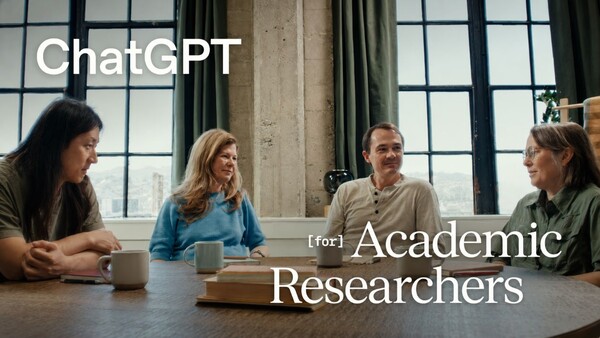
OpenAI said on Wednesday it has launched ChatGPT for Academic Researchers, offering researchers in science, mathematics and engineering free access for 1 year to advanced AI research tools including the GPT-5.6 model family and Codex.
The programme is designed to support researchers at selected universities and research institutions in using AI to solve complex research tasks and accelerate scientific discovery.
OpenAI plans to start the programme this summer for 10,000 researchers and expand support to as many as 100,000 by 2027.
Participants can use OpenAI's advanced models, including the GPT-5.6 model family, in ChatGPT, ChatGPT Work and Codex. It also provides access to GPT-5.6 Sol Pro for solving high-difficulty science and mathematics problems, expanded Deep Research access and higher usage limits.
It also offers more than 75 life-sciences research skills supporting genetics and genomics, protein modelling and new drug development, as well as connectors to scientific literature, public databases, satellite imagery and computing notebooks.
Codex supports code writing and debugging, dataset analysis and building reproducible research workflows. ChatGPT Work can be used to search for research funding opportunities and write applications, review literature and draft papers.
The dedicated workspace applies business-grade privacy and security features, and data entered by researchers is not used by default for training OpenAI models.
In the Asia-Pacific region, a total of 70 universities and institutions are included on the eligible list. Among them, 17 institutions are in South Korea, the most by country.
OpenAI said eligibility is not automatically granted just because a researcher is affiliated with an eligible institution. Researchers must apply individually by submitting their affiliation status, current research and plans for using AI.
 Seulgi Son
sageson@d-today.co.kr
Seulgi Son
sageson@d-today.co.kr