
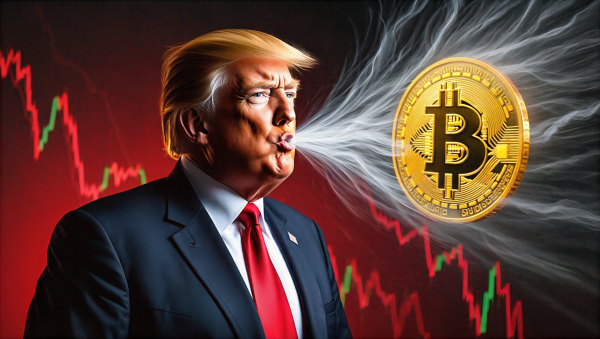
Talks in the U.S. Senate over the digital asset market structure bill known as the "Clarity Act" are struggling as they run up against conflict-of-interest issues involving U.S. President Donald Trump.
Blockchain outlet CryptoSlate reported on July 29 that during the Senate negotiations, Democrats have set as a core condition an ethics provision limiting how much senior officials, including the president and vice president, can profit from digital asset businesses.
The sticking point is that Republicans included an ethics limits provision in a draft released on July 22, but Democrats see it as insufficient. Democratic negotiators said ethics and conflict-of-interest safeguards must be strengthened, and Senator Elizabeth Warren (엘리자베스 워런) pointed to loopholes such as investment exceptions, affiliate structures and exclusive enforcement by the Justice Department. Democrats believe the current wording does not adequately prevent Trump or related businesses from continuing to profit.
The bill is crypto market structure legislation the industry has sought for years. The House passed the Clarity Act around July 2025 by 294 to 134, and the Senate Banking Committee also advanced the bill in May 2026. Still, it must resolve last-minute issues, including ethics provisions, to secure the Democratic votes needed for a final vote.
Trump's pro-cryptocurrency stance quickly translated into policy after he took office. At the "Bitcoin 2024" event in 2024, Trump pledged to replace Securities and Exchange Commission Chair Gary Gensler, appoint pro-crypto regulators, oppose a central bank digital currency, support bitcoin mining in the United States, and build a reserve stockpile of government-held bitcoin. In January 2025, the White House directed agencies to review crypto regulation and protect access to banking services, and two months later it created a strategic bitcoin reserve scheme funded by bitcoin the government had already seized.
The issue is that World Liberty Financial (WLFI), backed by the Trump family, launched before the presidential election around the same period. As Trump promised to change crypto regulation while a business bearing his name entered the same industry, conflict-of-interest concerns grew. Charles Hoskinson (찰스 호스킨슨), the founder of Cardano, said, "This DeFi business could be a burden on the industry," and said it could instead make Trump's push for crypto legislation more difficult.
In practice, Senate negotiations still have differences beyond the ethics provisions, including stablecoin rewards, states' enforcement authority, exceptions for SEC funding, anti-money laundering rules and investor protection. In this situation, Democrats say language limiting how senior officials such as the president and vice president issue or sponsor digital assets must be finalised before they back the bill.
The market is also lowering expectations for passage. Galaxy lowered its 2026 passage probability to 60 percent in June from 75 percent in May, and now sees it at effectively around 50 percent as the Senate schedule tightens further. The European Union is already implementing MiCA, and the transition period for crypto-asset service providers ended on July 1, 2026. For the United States, the Clarity Act is seen as determining whether it can create regulatory certainty based on law beyond administrative easing measures.
The picture could diverge sharply depending on the outcome of the Senate talks. If an enforceable ethics provision and a compromise on stablecoin rewards are reached, Trump would secure sustainable legislative achievements after swift administrative action. If a final vote is delayed by ethics provisions, stablecoin disputes or Senate scheduling problems, a 2024 warning could regain force that bipartisan legislation may become more difficult if the industry becomes too closely aligned with specific politicians.
 Yoonseo Lee
yslee@d-today.co.kr
Yoonseo Lee
yslee@d-today.co.kr