
South Korea's economic and financial authorities will set individual investment limits on single-stock leveraged exchange-traded funds (ETFs) tied to Samsung Electronics and SK Hynix. They will also establish a legal basis to allow stabilisation steps such as adjusting leverage multiples if markets swing sharply.
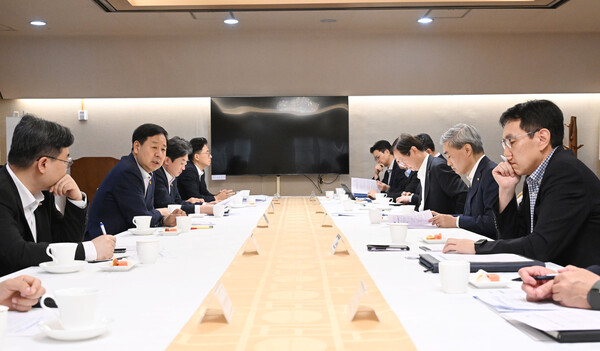
Deputy Prime Minister and Finance and Economy Minister Koo Yun-cheol (구윤철) on July 29 held an emergency market situation review meeting at the Government Complex Seoul to discuss additional responses for single-stock leveraged ETFs.
The meeting was attended by Bank of Korea Governor Shin Hyun-song (신현송), Financial Services Commission Chairman Lee Eok-won (이억원), Financial Supervisory Service Governor Lee Chan-jin (이찬진) and other heads of financial authorities, as well as Ha Joon-kyung (하준경), senior presidential secretary for economic growth at Cheong Wa Dae.
Authorities decided to manage total trading volume by setting individual investment limits for single-stock leveraged ETFs. A specific cap has not been finalised, but an option presented as an example would limit it to within 20 percent of total investment amount.
They will also prepare a legal basis so authorities can take direct stabilisation measures in urgent market conditions. The authorities are expected to review adjusting a product's leverage multiple depending on market conditions by referring to overseas examples such as Hong Kong's variable leverage system.
They also plan to impose trading costs to reduce excessive orders. The plan is to apply charges such as excessive order surcharges used in the futures market to single-stock leveraged ETF trading to raise the cost burden for repetitive and excessive orders.
As an investor protection measure, simulated trading will be added. It will add a simulated investment process similar to actual trading to the current pre-investment education, encouraging investment only after sufficient understanding of product structure and potential losses.
Authorities decided to push immediately for individual investment limits, the legal basis for market stabilisation measures, excessive order surcharges and the introduction of simulated trading.
A previously announced increase in the basic deposit requirement will also take effect from July 31. The basic deposit needed to invest in single-stock leveraged ETFs will rise from 10 million won to 30 million won in cash.
Participants diagnosed the recent sharp fall in South Korea's stock market as stemming from a combination of weakened investor sentiment and unstable supply-demand conditions during a correction after share-price gains, which widened losses.
They said the economic fundamentals still looked solid, considering strong exports in key items such as semiconductors, upward revisions to corporate earnings outlooks and an expanding current account surplus.
Economic and financial authorities plan to further analyse why South Korea's stock market showed greater volatility than major overseas markets. They also plan to maintain the highest level of vigilance for the time being and continue 24-hour market monitoring.
 Oh Sang-yup
yub@d-today.co.kr
Oh Sang-yup
yub@d-today.co.kr