
SK Hynix presented this year’s investment scale at the high 40 trillion won range. What underpinned a 76 percent operating margin in the second quarter was depreciation and amortisation of intangible assets that totalled only 4 trillion won against revenue of 79.3187 trillion won. An analysis said that as this investment begins to be reflected in depreciation, it would be difficult to maintain the same profit margin structure. Questions on the conference call also focused on the investment burden, the possibility of oversupply, long-term supply agreement terms and shareholder return plans.
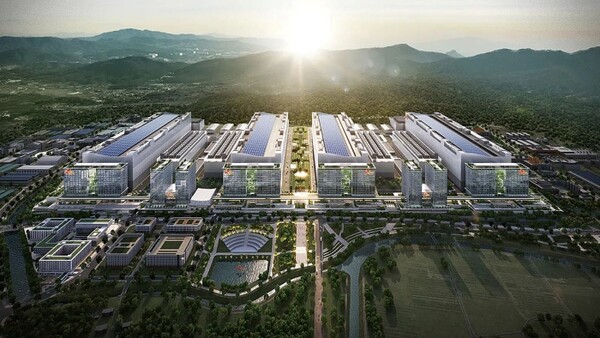
SK Hynix said on the second-quarter conference call held on Tuesday that it is expanding investment to secure the ability to respond to supply needs. It said it is bringing forward the mass production schedule for M15X and investing so it can quickly expand capacity after the cleanroom opens at its first Yongin fab in early 2027. It also presented plans for the advanced packaging plant P&T7, a new NAND flash production base M17 and the creation of a new domestic semiconductor cluster. The company said it will proceed step by step with fab construction, equipment installation and capacity expansion, considering customer demand visibility and investment efficiency.
Concerns about oversupply were raised because large-scale investment is continuing. The company responded that because capacity expansion is carried out flexibly based on confirmed demand, the likelihood that a medium- to long-term increase in investment would directly lead to oversupply is limited. It added that there are no decisions on additional new production infrastructure investment beyond the plans already announced.
The company said its basic direction is not to divide future production bases into domestic and overseas, but to review the optimal plan by comprehensively considering power and water, workforce, supply chains, the semiconductor ecosystem and customer accessibility. In South Korea, it plans to foster Icheon and Yongin as production bases for next-generation DRAM and AI memory, and Cheongju as a base spanning NAND flash and advanced packaging.
Uncertainty over long-term supply agreements, or LTAs, also exists. The company said it has completed LTA negotiations with about 10 companies, including key customers, and that the contract period is typically 5 years. While it is a device to defend the downside in performance, it is also a condition that constrains the upside when average selling prices for DRAM rise 30 percent in a quarter and NAND flash ASP rises in the mid-50 percent range. The company did not disclose the share of LTA in total sales and only said it would manage it at an appropriate level.
It also confirmed adjustments in set demand. The company said temporary sales adjustments are appearing in PC and mobile applications due to difficulty securing memory volumes. That means price strength is weighing on end demand. The company said it expects growth momentum to recover as supply shortages ease and AI services spread, but the timing of a recovery depends on when supply constraints are lifted.
Criticism was also raised that the second-quarter increase in DRAM ASP fell short of market expectations. The company said the timing of expanded shipments of some high value-added products was pushed back to the second half, and that the portfolio mix affected blended ASP. It said it expects this factor to ease in the second half as HBM4 volumes increase and shipments of general DRAM based on 1c nanometre technology rise.
These factors intersect at once when prices turn down. The current profit margin has been created by supply constraints, but the company’s investment in the high 40 trillion won range is moving in a direction that loosens those constraints and will also return as depreciation costs after 2027. If ASP falls when depreciation rises, the speed of margin contraction could be as fast as during an upswing. LTAs defend the downside in this section, but because they are fixed for 5 years, they cap the upside when prices rise again.
Another variable is that it is difficult to gauge the size of the defence and the constraint because the company does not disclose the proportion. If sales adjustments in PCs and mobile devices are prolonged, it is also unconfirmed how far AI demand can fill the gap in set demand.
Cash pile of 88 trillion won, but shareholder returns still under review
The company presented a balance between timely execution of future investment, maintaining a stable financial structure and returns to enhance shareholder value as its capital allocation goals. Among them, shareholder returns remain undecided. Cash and cash equivalents stood at 88 trillion won at the end of the second quarter, and net cash was 69.4 trillion won.
The company said it is reviewing additional shareholder return measures from various angles, but the method, size and timing have not been decided. It cited regulatory and procedural constraints related to a U.S. ADR offering, saying it is difficult at this time to disclose information not revealed during the offering process. It said it plans to share specific measures with the market within this year once they are finalised.
As concerns were raised one after another, the stock moved in the opposite direction from results. In the KOSPI market on Tuesday, SK Hynix traded at 1,280,000 won, down 270,000 won, or 17.42 percent, from the previous session. The previous day’s close was 1,550,000 won, with volume of 7,589,882 shares. It recorded a double-digit decline on the day it announced a record quarterly result, which was interpreted as reflecting a lack of specificity in the company’s answers on the method and timing of shareholder returns and its cost structure after 2027, rather than the earnings figures.
Supply and demand variables surrounding the ADR also remain. SK Hynix listed ADRs on Nasdaq on July 7. The company said ADRs can be freely converted into ordinary shares from July 30, the day after the listing of the ordinary shares on the Korea Exchange is completed. By contrast, converting ordinary shares into ADRs may typically take several weeks or longer due to regulatory filing procedures, and the ADR conversion limit is set at 17.79 million shares. The company said it has not decided whether to increase the proportion.
 Suk Dae-geon
d2dg@d-today.co.kr
Suk Dae-geon
d2dg@d-today.co.kr