
SK Hynix has concluded negotiations on long-term supply agreements (LTAs) with about 10 customers, including core clients. The contract term is typically five years. Along with customers’ purchase commitments, the deals include financial arrangements such as deposits to support performance of the contracts. The structure allows the memory supplier to secure both five-year volumes and performance collateral.
Song Hyun-jong (송현종), head of the corporate centre at SK Hynix, said on July 29 on the company’s 2026 second-quarter earnings conference call, "This LTA goes beyond a simple volume supply and has the nature of a strategic partnership to secure mid- to long-term supply stability and develop next-generation memory in line with customers’ technology roadmaps." The company said it is also continuing additional discussions with major industry customers.
The company expects tight supply and demand conditions in the memory market to continue for a considerable period. It said the difficulty of advanced processes applied to HBM and AI server memory is increasing and building new production facilities requires lead time, making it difficult for the supply-demand environment to improve in the short term. The company said customers’ willingness to secure mid- to long-term supply stability has strengthened in this phase.
That has also aligned the price structure with profitability. The company said LTA pricing has been designed in various ways depending on customer and product characteristics to respond to price volatility. It did not disclose the share of total sales accounted for by LTAs. The company said it will manage them at an appropriate level in consideration of the market environment and customer demand, while improving downside stability of performance and maintaining flexibility to capture additional demand when the market is favourable.
The company said it has already secured a stable profitability base centred on HBM, supported by long-term cooperation with major AI customers including Nvidia. To secure supply responsiveness, it is bringing forward the mass production schedule for M15X. It is also making investments to rapidly expand production capacity after the cleanroom opens at the Yongin Phase 1 fab in early 2027. This year’s investment is expected to be in the high 40 trillion won range.
Mass production shipments of HBM4 began in the second quarter. The company said current mass production yields are close to the level of the previous-generation products whose yields and quality have entered a mature stage. It said this is a metric that is difficult to achieve in the initial ramp-up stage of a new product and supports expanding production in the second half. The company said HBM4 achieves the operating speed demanded by customers while also delivering power efficiency and cost competitiveness.
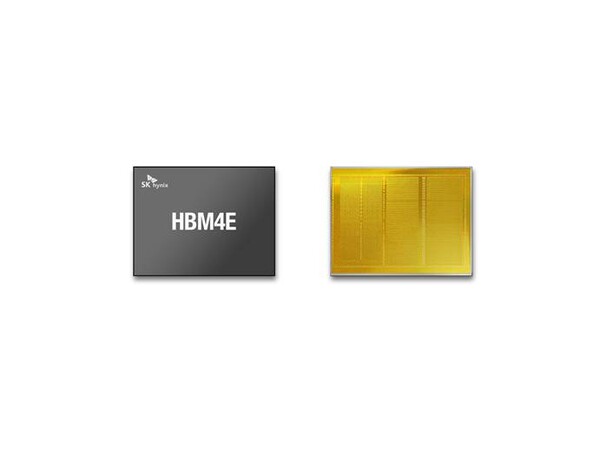
The company completed sample supplies of HBM4E to major customers in the first half. It said it applied a process with technological maturity and mass production stability, and development is under way with a goal of full-scale mass production in 2027. As next-generation technologies, it is developing iHBM along with hybrid bonding. It said the technology places cooling elements inside the package to cut thermal resistance by more than 30 percent from existing levels, targeting heat control for next-generation products such as HBM5.
Asked about an assessment that a competitor’s HBM competitiveness is improving rapidly, the company responded that competitiveness is not completed by performance implementation alone. The competitor appears to be Samsung Electronics. Recently, Samsung Electronics quickly completed sample shipments and entered a phase of preparing for mass production, unlike when it competed on HBM3E timing.
SK Hynix said capabilities must also include being able to supply in volume the performance customers demand with stable yields and quality. The company said the competitiveness it has built up across time to market, product performance, mass production yields, quality and overall customer trust is a differentiating factor that is difficult to secure in a short period. It added that because HBM is a high value-added product, defects can significantly increase customer costs and affect overall systems.
HBM4E samples supplied, mass production targeted for 2027
The company said it is discussing 2027 HBM supply volumes and prices with major customers. It said a rise in general DRAM prices could partly affect HBM price discussions, but drew a line that HBM prices are not determined solely by movements in general DRAM prices. It cited larger inputs of wafers and advanced processes, TSV and packaging capacity compared with general DRAM, and increasing complexity in development and certification processes as generations advance. It did not disclose contract terms with individual customers or specific prices.
The company is also expanding its product lineup in NAND flash. It said as the AI market expands from training 중심 to inference-centric, NAND is changing into a key element forming the memory hierarchy of AI systems. It plans to respond with high-capacity QLC-based eSSDs for AI data lakes and areas replacing hard disk drives (HDDs), and with a new tier of AI storage products for new applications such as KV cache offloading.
For third-quarter shipment plans, DRAM is expected to increase by about 10 percent from the previous quarter, and NAND flash by low single digits. The company said it expects bit growth in the second half to exceed the first half, citing expanded HBM4 volumes and increased shipments of 1c-nanometre-based general DRAM. It also said expanded HBM4 sales and a rising share of high value-added products will contribute to blended average selling prices (ASP).
In the second quarter, DRAM ASP rose by about 30 percent and NAND flash ASP climbed to the mid-50 percent range. How volumes secured through LTAs and the HBM4 ramp-up align with this pricing phase remains a variable for second-half performance.
 Daegeon Seok
d2dg@d-today.co.kr
Daegeon Seok
d2dg@d-today.co.kr