
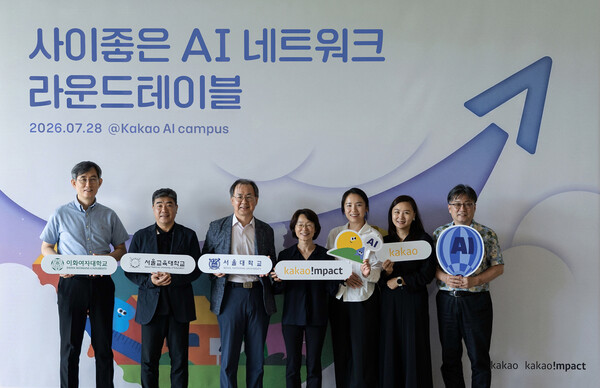
Kakao Impact Foundation, or Kakaoimpact, said on Tuesday it has launched an expert consultative body, the Saijoun AI Network, to take charge of building an education framework for future generations in the age of artificial intelligence (AI).
Kakaoimpact held a launch roundtable on Monday at the Kakao AI Campus to discuss follow-up tasks. A key goal is to fully expand its youth digital citizenship education programme, "Saijoun Digital World," which it has run for 11 years since 2015, into the AI field. It plans to build a new "AI citizenship education" model and curriculum to help teenagers develop the capability to use AI proactively and responsibly.
The new education model adds metacognition and resilience, seen as essential capabilities in the AI era, to the existing seven digital citizenship competencies: emotion and empathy, digital etiquette, cyberbullying prevention, digital and AI literacy, personal information protection, copyright, and online identity. It combines metacognition to critically judge AI-generated results with resilience to turn failure into an asset even in an environment where answers come quickly.
The consultative body will run on a two-track basis with advisory members and expert members. AI experts including Kakaoimpact chair Ryu Seok-young (류석영), Hanyang University professor Lee Sang-wook (이상욱), Hanyang University professor Kim Eun-sol (김은솔) and KAIST professor Kim Joo-ho (김주호) will advise on the education direction. Education experts including Seoul National University professor Jung Chang-woo (정창우), Ewha Womans University professor Ok Hyun-jin (옥현진) and Seoul National University of Education professor Kim Bong-je (김봉제) will lead on-site curriculum research as industry-academia cooperation heads at their universities.
Jung Chang-woo, a professor in the Department of Ethics Education at Seoul National University, said, "AI has deeply entered teenagers' daily lives, but research that systematically defines and diagnoses the civic competencies they need is still at an early stage." He added, "We will establish the concept of AI citizenship and its core competencies, and develop a diagnostic measurement tool, AQ, to lay the groundwork for schools."
Kakaoimpact will run its existing programme this year for 1,000 classes nationwide, or about 20,000 people, to strengthen its on-the-ground base. It plans to hold a symposium in October to unveil for the first time the AI citizenship education model and AQ, a tool for measuring competencies. After pilot operations at schools in November and December, it plans to expand AI citizenship education nationwide in earnest from 2027.
Ryu said, "In the AI era, citizenship that correctly understands AI and uses it responsibly is even more important, not just the ability to use technology." He added, "Based on 11 years of accumulated experience in digital citizenship education, we will build an AI citizenship education model that can be used in schools."
 Lee Ho-jung
lhj@d-today.co.kr
Lee Ho-jung
lhj@d-today.co.kr