
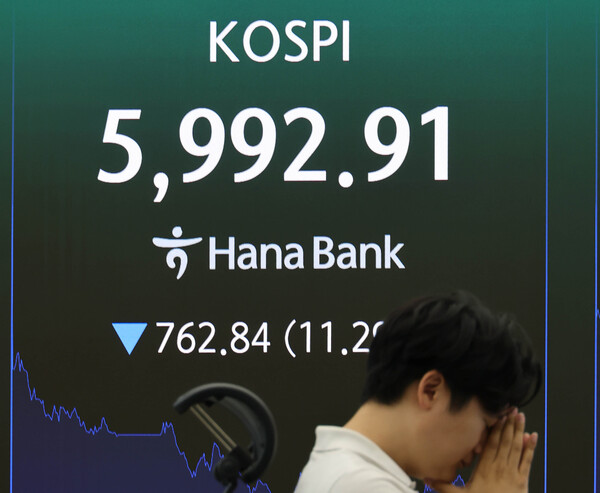
With the KOSPI tumbling more than 10 percent in a day, analysts at brokerages say the likelihood of a short-term rebound has risen due to an oversold decline. They cautioned, however, that investors should judge whether the trend has turned only after confirming improvements in foreign inflows, the exchange rate and corporate earnings.
On July 28, the KOSPI closed at 6,023.63, down 732.12 points, or 10.84 percent, from the previous session. The KOSDAQ fell 59.00 points, or 7.71 percent, to 705.86. In both markets, a sell-sidecar was followed by a stage-one circuit breaker.
Kim Seok-hwan (김석환), a researcher at Mirae Asset Securities, attributed the sharp fall to worries about China catching up in semiconductor technology and expanding supply, doubts about monetising artificial intelligence (AI) investment, and forced reductions of positions concentrated in semiconductors and single-stock leveraged products.
Rather than the emergence of a new recession signal, he said existing risk factors met excessive positioning and thinning liquidity and were reflected in prices all at once.
Analysts also cited the limited scale of downward revisions to corporate profit forecasts compared with the KOSPI's more than 10 percent drop as evidence the move was far from a collapse in fundamentals.
They also pointed to the relatively stable currency market as a factor reducing the likelihood of a systemic crisis. Despite the stock plunge, the won-dollar exchange rate closed at 1,461.60 won, down 4.40 won from the previous session.
The assessment was that selling was more likely concentrated in adjustments to semiconductor and leveraged positions than in country risk or a shortage of dollar liquidity.
Lee Jae-man (이재만), head of global investment analysis at Hana Securities, said that in past rebounds after sharp index drops, sectors that had led the previous rally tended to regain strength.
After the dot-com bubble burst, the brokerage sector rose 24 percent over 1 month from the bottom, 55 percent over 3 months and 141 percent over 6 months. After the global financial crisis, the shipbuilding sector gained 26 percent, 63 percent and 107 percent over the same periods.
After the 2022 shock from interest rate hikes, secondary batteries rose 23 percent over 1 month, 25 percent over 3 months and 75 percent over 6 months. After the 2025 tariff shock, power equipment climbed 32 percent, 66 percent and 127 percent, leading the index rebound.
Semiconductors, IT hardware and power equipment, which led this year's rally, were down 34 percent, 40 percent and 24 percent, respectively, from their peaks as of July 27. If earnings forecasts hold, a rebound could emerge centred on sectors seen as oversold, the analysis said.
Samsung Electronics' decline has also neared levels seen in past major crises. Lee said Samsung Electronics' maximum drawdown from its peak was 39.3 percent based on the intraday low on July 28. That is close to 46.6 percent during the 2008 financial crisis and 42.4 percent during the 2025 period of domestic political instability and the U.S. tariff shock.
By contrast, Samsung Electronics' 12-month forecast operating profit slipped only about 1 trillion won, to 475 trillion won from 476 trillion won. The analysis said the valuation adjustment appeared excessive given that earnings forecasts changed little compared with the share-price fall.
Han Ji-young (한지영), a researcher at Kiwoom Securities, also said news that China is developing deep ultraviolet (DUV) lithography equipment, a break below the 120-day moving average, and caution ahead of major companies' earnings announcements worsened investor sentiment.
Han said that after a chain of corrections the market's resilience has weakened, leading to an excessive reaction to negative factors. He said no realistic slowdown has appeared in earnings and fundamentals, and that valuation, the relative strength index (RSI) and the disparity ratio point to an oversold zone.
Some also said an initial rebound should not be interpreted immediately as a shift into an uptrend. A short-term bounce can occur on oversold conditions, short-covering of short sales and futures short covering alone.
Kim said investors should check turnover, the scale of foreign selling and whether program selling is easing during the first rebound. He said judging a trend turn would require checking whether the KOSPI holds its previous low, semiconductor earnings and price outlooks, foreigners' net buying in the cash market and whether the exchange rate stabilises.
Jo A-in (조아인), a researcher at Samsung Securities, also urged a selective response, saying the market has entered a technically oversold phase but uncertainty has not been fully resolved. He said investors holding cash should buy in tranches after considering sector-by-sector earnings outlooks and financial stability, while existing investors should examine company fundamentals rather than the index decline.
Yang Hyeong-mo (양형모), a researcher at DS Investment & Securities, said the market as a whole has moved to a phase where the likelihood has increased of building positions in tranches rather than handing over holdings in fear. He said individual stocks should be approached only after confirming a fresh upward breakout, and that investors need to distinguish whether an initial rebound is a trend turn or a technical bounce.
 Sangyeop Oh
yub@d-today.co.kr
Sangyeop Oh
yub@d-today.co.kr