
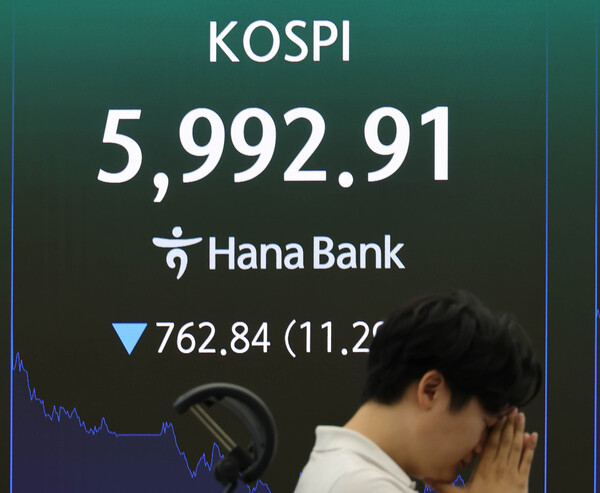
South Korea's stock market faced what was dubbed "Black Tuesday" on July 28. The KOSPI broke below the 6,000 level intraday and the Kosdaq fell through 700. Both markets triggered a sell-side sidecar, followed by a first-stage circuit breaker.
According to the Korea Exchange, the KOSPI ended down 732.12 points, or 10.84 percent, at 6,023.63 from the previous session.
The KOSPI opened at 6,400.27 and extended losses, falling to as low as 5,992.91 during the session. It was the first time in 105 days that it traded below 6,000 intraday since April 15, when it had recovered from the fallout of the U.S.-Iran war.
Soon after the open, a sell-side sidecar was triggered, temporarily halting the effectiveness of program sell orders. As selling continued, a first-stage circuit breaker was activated at 10:13 a.m. when the KOSPI fell 8.02 percent to 6,213.51.
Trading in all stocks on the main board was suspended for 20 minutes. It was the eighth time this year that a KOSPI circuit breaker was triggered and the 14th since the system was introduced.
In the main market, foreigners were net sellers of 49.592 trillion won. Retail investors were net buyers of 43.180 trillion won and institutions bought a net 6.387 trillion won, absorbing foreign selling.
Most top market-cap stocks plunged, except Samsung Biologics.
Samsung Electronics closed down 34,000 won, or 13.39 percent, at 220,000 won. SK Hynix fell 266,000 won, or 14.65 percent, to 1,550,000 won.
SK Square fell 15.60 percent, Samsung Electro-Mechanics dropped 15.92 percent, Hyundai Motor declined 9.68 percent, Samsung Life fell 8.51 percent and LG Energy Solution slid 5.71 percent.
Samsung Biologics, by contrast, ended up 0.26 percent at 1,549,000 won.
The Kosdaq closed down 59.00 points, or 7.71 percent, at 705.86 from the previous session. It hit an intraday low of 697.45, falling below 700 for the first time in 1 year and 3 months. It recovered 700 by the close after paring losses.
The Kosdaq also triggered a sell-side sidecar, followed by a first-stage circuit breaker at 12:01 p.m. At the time, the Kosdaq was down 8.09 percent at 702.91, suspending market trading for 20 minutes.
In the Seoul foreign exchange market, the won-dollar exchange rate ended down 4.40 won at 1,461.60 won per dollar from the previous session.
The sharp fall is seen as driven by weak U.S. semiconductor shares, alongside concerns that news of China's development of deep ultraviolet (DUV) lithography equipment for semiconductor manufacturing would expand memory supply and intensify competition.
Ah-in Cho (조아인), an analyst at Samsung Securities, said concerns over China's semiconductor technology self-reliance, rising credit default swap (CDS) premiums for artificial intelligence (AI) companies, and wariness ahead of earnings from major U.S. big tech companies and the Federal Open Market Committee (FOMC) dampened investor sentiment.
Ji-young Han (한지영), an analyst at Kiwoom Securities, said, "With the investment narrative for semiconductor stocks damaged, news out of China, a break below the 120-day moving average, and wariness over earnings at major companies overlapped."
Han added, "The current crash has a strong excessive character, and a realistic slowdown in fundamentals such as earnings has not yet appeared," and said, "Technical indicators such as valuations, the relative strength index (RSI) and price divergence are also pointing to oversold territory."
 Sangyeop Oh
yub@d-today.co.kr
Sangyeop Oh
yub@d-today.co.kr