
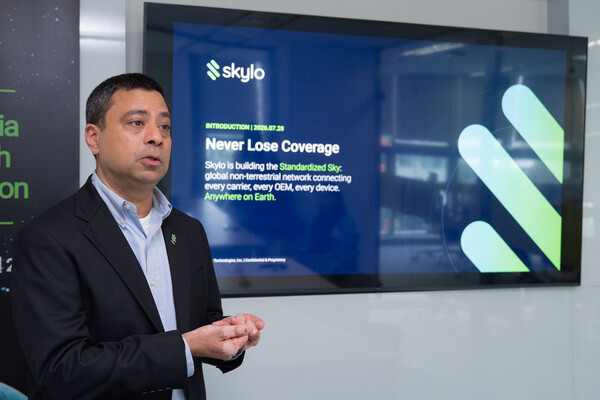
A service that allows people to use satellite communications on regular smartphones in areas beyond mobile network coverage is stepping up its push into the South Korean market. The idea is to connect smartphones directly to satellites without dedicated devices or external antennas, addressing coverage dead zones.
Global non-terrestrial network (NTN) technology company Skylo Technologies held a technical briefing in Seoul’s Yongsan district on July 28 and disclosed its direct-to-device (D2D) satellite connectivity technology and global business status.
Skylo is a satellite connectivity technology company founded by engineers and scientists from the Massachusetts Institute of Technology and Stanford University. Investors include the Samsung Catalyst Fund, Intel Capital and BMW i Ventures, and it has raised a cumulative $180 million.
D2D is a technology that enables smartphones to communicate directly with satellites in places without mobile base stations. It uses chipsets and devices compatible with mobile standards, rather than dedicated antennas and separate terminals like conventional satellite communications.
Based on 3GPP standards, Skylo supports connections among satellite operators, mobile carriers, chipset makers and device manufacturers. It can apply the same type of satellite connectivity not only to smartphones but also to smartwatches, cars and Internet of Things (IoT) devices, broadening its use. Another strength is that existing mobile subscribers can keep using the same SIM and handset.
Tarun Gupta (타룬 굽타), Skylo’s co-founder and chief business officer (CBO), stressed that satellite networks would complement, not replace, terrestrial mobile networks. He said they can be used not only in mountainous and island areas but also on highways and at sea, where communications quality can be unstable while on the move, helping reduce connectivity gaps in coverage dead zones.
“Satellite communications deliver the first signal of connection in places that terrestrial networks cannot reach,” Gupta said. “They can be a means to save lives in urgent situations, such as vehicles stranded in snow or ships drifting at sea,” he said.
Skylo’s technology supports satellite communications at various altitudes, including geostationary, medium Earth orbit and low Earth orbit satellites. Its commercial service is currently provided mainly through geostationary satellites. The company says it can expand service without new satellite launches or large-scale ground infrastructure because it links already-launched satellites with existing commercial devices.
It already operates commercial satellite connectivity services in 37 countries across five continents. As of June 2025, it had connected about 7 million devices to its network. It is working with Samsung Electronics, as well as Google, Qualcomm, Verizon, Orange and Garmin, to broaden its reach.
For mobile carriers in particular, partnering satellite operators can use licensed spectrum they hold without carriers having to repurpose their own spectrum for satellite use, reducing the initial investment burden. Carriers can seek stronger profitability by bundling satellite connectivity into existing plans or offering it as part of premium plans and as separate add-on services.
“South Korea has well-built mobile infrastructure, but some areas and mobile environments still need connectivity reinforcement,” Gupta said. “Because we can use existing satellites and commercial devices, we will be able to expand service without large-scale facility investment,” he said.
He also said carriers can raise average revenue per user (ARPU) and reduce churn among existing subscribers. He said it can also expand business into areas where it was difficult to provide services using only existing mobile networks, including maritime and mountainous sectors, logistics and automobiles.
Skylo is currently discussing the possibility of introducing services with South Korean mobile carriers. It did not disclose specific partners or the timing for a domestic service launch. The company’s policy is to provide services in line with local laws and systems through consultations with regulators in each country.
Skylo also demonstrated an emergency rescue request service using a regular smartphone. Users select a mode of transport such as a car or ship and enter their current situation, and a rescue request message is delivered via the satellite network. Depending on national systems and service operations, it can also be linked to local rescue agencies such as police and fire authorities.
 Jin-ho Lee
jhlee26@d-today.co.kr
Jin-ho Lee
jhlee26@d-today.co.kr