
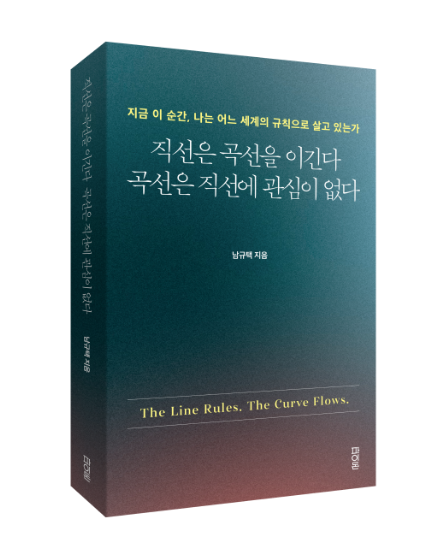
Publisher Phaidon has released a book titled "Straight lines beat curves; curves have no interest in straight lines," which focuses on uniquely human values that technology cannot replace in the AI era.
In the book, author Nam Gyu-taek (남규택), a former head of KT’s marketing division, stresses that more important than the speed of change is the ability to judge direction.
According to the publisher, people typically move twice a day between worlds that operate by completely different rules. In the brief moment of entering a building on the way to work and leaving it on the way home, they cross into another world.
In the world of workplaces and organisations, efficiency, performance and achieving targets matter. The shorter the route, the better, and a wrong choice quickly returns as an evaluation. This world moves in straight lines. The world after leaving the building is different. With family, neighbours and long-time friends, it is fine not to reach a specific point, and relationships endure without proving usefulness. Straight lines always beat curves. Curves, for their part, do not beat straight lines, but do not step onto the same playing field in the first place.
Problems arise when people confuse the rules while moving between the two worlds. Inside an organisation, they must take responsibility as beings that fulfil essential roles, and when the day’s work ends, they must stop calculating and return as existential beings who restore relationships. The moment these two are swapped or mixed, people lose their footing in the world of performance and lose trust in the world of relationships.
The author captured in the book what he saw and experienced over 35 years moving directly between the boundaries of the two worlds.
The material ranges from philosophy and the history of science to organisational culture, social phenomena, AI and platform capitalism, but the question narrows to: "At this moment, by the rules of which world am I living?"
At a time when technology is reshaping all areas of life in the name of efficiency and convenience, the author examines what it means to be a human who thinks, empathises and takes responsibility, and what uniquely human values technology cannot replace as AI pushes deeply into the realm of judgment and choice.
After a long career in the workplace, the author published "The Lowest Marketing Story," which reflects his corporate experience, and "56 Essential AI Terms Explained in the Language of the Humanities," which unpacks AI concepts in everyday language from a humanities perspective.
"Straight lines beat curves; curves have no interest in straight lines" is his third book, and it is not about technology or management strategy but asks questions about people, society and community. He put discomfort, warmth and passing questions from scenes encountered in meeting rooms, on the road and in newspaper articles into short essays of 2 to 4 pages each. Nam said, “I could not design a way to change society. I just wanted to leave a temperature that lets people think.”
The author graduated from Yonsei University’s economics department and earned a master’s degree in management science at KAIST. He served as head of KT’s marketing division and as CEO of KTCS. He is currently vice chairman of urban air mobility company Ghenus Air.
 Chi-gyu Hwang
delight@d-today.co.kr
Chi-gyu Hwang
delight@d-today.co.kr