
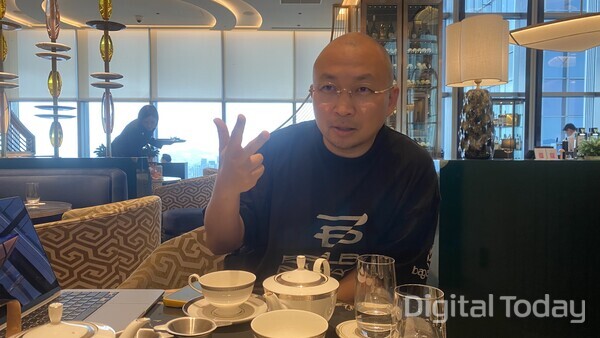
[Digital Today reporter Seul-gi Son] "We need to pursue a moat-centered AI strategy like what SK Hynix and Samsung Electronics have shown."
Cho Yong-min (조용민), CEO of venture investment firm Unboundlabdev, stressed that for South Korea to expand its stake in the global AI market it should focus investment on areas of AI infrastructure bottlenecks rather than competing with big tech on general-purpose AI model performance.
Cho recently met with reporters and said South Korea should invest in bottlenecks in manufacturing and infrastructure, where it is strong. He cited four main bottlenecks in the AI industry: memory, interconnect, thermal management and power.
He invested in Anthropic in 2022, before the generative AI market began to grow in earnest. Harvey, Abridge and SpaceX are also among key investments in his portfolio.
He said that as AI models improve and data centres grow, the importance rises not only of high-bandwidth memory (HBM) but also of interconnects that link chips and servers, cooling technology that removes heat generated by equipment, and technology that supplies power reliably.
He said AI bottlenecks keep shifting from memory to interconnect, and then to thermal management and power. He said South Korean companies, along with U.S. firms, are performing well in those areas, and that many have stronger technology than China. He added that companies could emerge in those fields that play roles like Samsung Electronics or SK Hynix in the future.
As an example, Cho cited Company A, which is building an AI operating system that runs on closed networks at manufacturing and defence sites instead of directly developing a general-purpose model. It detects signs of equipment abnormalities and analyses industrial documents to feed into production and maintenance decisions.
Cho said the competitiveness of such companies comes not from model benchmark scores but from how deeply they penetrate customers' work. He said a general-purpose model can be swapped out if a better product appears, but systems integrated into production lines and work procedures are hard to replace in a short period.
Citing the content industry, he said the goal is not to rebuild YouTube but to create BTS that YouTube cannot ignore. He said it is not about setting out to build Netflix but about making Squid Game that Netflix needs.
Cho again stressed that government AI investment policy should focus more on areas where South Korea is already strong, rather than competing with global big tech over AI models. "You have to look at technical logic and global competitiveness. South Korea needs to find the value chains it already does well and deploy capital there," he said.
Cho said a system in which the government defines projects, creates dedicated organisations and then selects already known companies for support makes it hard to keep up with bottlenecks in the fast-moving AI industry. He said that rather than giving more money to already known companies and technologies, it should first identify where the next bottleneck will occur.
He said there is a need to focus on finding points in the global AI industry where it is difficult to replace South Korea.
"It is not AI itself that is important, but what problem you will redefine," Cho said. He said South Korea should move away from the notion that it must have at least one model of its own and rebuild its investment logic around value chains it is good at and bottlenecks that will arise.
 Seul-gi Son
sageson@d-today.co.kr
Seul-gi Son
sageson@d-today.co.kr