
[Digital Today reporter Ho-jung Lee (이호정)] Kakao is releasing the small language model (SLM) version of its in-house artificial intelligence model, Kanana, as open source to strengthen its technological competitiveness and expand its ecosystem.
Kakao on Monday released four lightweight language models as open source on global AI platform Hugging Face that can run directly in limited device environments such as smartphones. The lineup distributed this time is the Kanana-2 series: Kanana-2-1.3B-base, Kanana-2-1.3B-instruct, Kanana-2-3B-base and Kanana-2-3B-instruct.
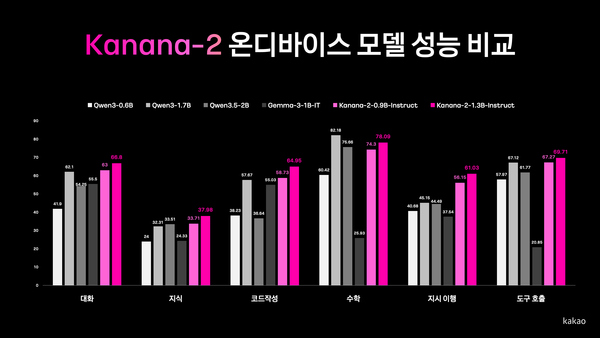
The company said the models deliver global-level performance in both Korean and English despite their small size. It said they posted strong results across most major benchmarks for Korean, English, knowledge, math and code compared with the latest open-source models of a similar size.
In particular, Kanana-2-0.9B-instruct, a smaller model developed alongside Kanana-2-1.3B-instruct, showed competitive indicators against global models in the same class such as Qwen and Gemma in practical service capabilities including conversation, knowledge, code, math, instruction following and tool calling.
Kakao also applied its in-house Korean-specialised tokenizer, boosting Korean processing efficiency by more than 30 percent compared with before. A tokenizer is a core technology that determines the units into which an AI model breaks sentences when processing text. The more a tokenizer is optimised for Korean, the fewer units it needs to compute the same sentence, which speeds up processing and reduces operating costs. Kakao applied a Korean-specialised tokenizer it completed developing last year across the models.
The lineup has completed an optimised design for on-device environments with limited memory and computing resources. It introduced a sliding window attention structure to address a bottleneck in which memory usage rises sharply when handling long conversations. This allows stable performance while cutting memory use by up to 72.7 percent even in conversations up to 32K tokens, or about 24,000 words, in length.
Kakao is distributing the models under the Kanana Open License, which allows commercial use. It said anyone, including developers, research institutions and companies, can use the technology without additional restrictions, which is expected to contribute to expanding the domestic foundation for using high-performance Korean AI models and energising new service development. Kakao is already applying technologies accumulated during the development process to real services including Kanana in KakaoTalk, KakaoTalk chat summaries and call summaries, and the AI National Secretary service.
Noh Byung-seok (노병석), performance leader for Kakao's unified foundation model, said, "As we prepare for the agentic AI era, we are realising the importance of both large-scale AI in the cloud and lightweight on-device AI." He added, "Kakao is enhancing its technological competitiveness in both areas, and we hope these open-source models will lead to the development of new AI services by more developers and companies and contribute to revitalising the domestic AI ecosystem."
 Ho-jung Lee
lhj@d-today.co.kr
Ho-jung Lee
lhj@d-today.co.kr