
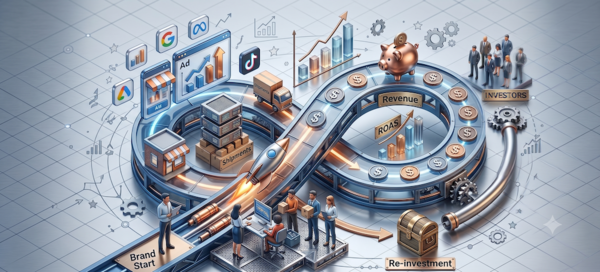
[Digital Today reporter Daegeon Seok] Advertising is the starting point for growth at online shopping malls, but brands first run into the burden of funding. Ad results can only be checked after campaigns run, but costs arise earlier. Cafe24 stresses that this upfront-payment structure should be changed through "sales-linked advertising" that settles ad costs after sales occur.
Advertising is the fastest way to promote products, attract customers and generate sales. But brands must pay ad costs before verifying performance, and they cannot recover money already spent even if results fall short. That means brands have to worry about funding burdens before ad strategy.
This structure also divides the speed at which brands grow. Brands with secured funds test multiple products and creatives at the same time and quickly verify results. Brands with limited funds have to hesitate about advertising itself or run only minimal budgets. The biggest loss comes not when ads fail, but when a brand cannot even start. Even if a product is competitive, it will not sell and will remain as inventory if it does not get a chance to be tested in the market.
Efforts to push back the initial funding burden are also continuing overseas. Ireland's Wayflyer and Britain's Outfund provide revenue-based financing services to e-commerce brands. It is a model that helps brands secure working capital based on future sales so they do not miss growth opportunities.
Their services differ in structure from settling ad costs after performance because they provide financial products. Still, the direction is the same in that they delay the burden of having to raise costs first. That means the flow of reducing initial funding burdens to support growth is also extending to how advertising is run.
Cafe24 Marketing Center's sales-linked advertising is also part of that flow. It runs campaigns without paying or preloading ad costs in advance, then settles once sales occur. It covers major ad platforms including Google, Meta, TikTok, Naver and Kakao, and is designed to lower initial cost burdens so brands can quickly test more products and strategies, the company said.
◆ Funding, not products, determined ad success or failure
Cafe24 presented two points where sales-linked advertising is effective. One is the initial stage of starting advertising. It lets brands experiment with various products and strategies without 부담 even when there is not enough verified data. The other is the stage of scaling performance. Even when ads begin to work, many brands cannot keep running campaigns or delay expansion due to budget burdens, and the model helps them grow verified strategies in a timely way, it said.
Cafe24 said this is not simply a change in payment method. It is an operating approach that helps brands move faster through the whole process of starting ads, checking performance and expanding scale.
Cafe24 said the change is confirmed in actual operating cases. Underwear brand Shoobibi adopted sales-linked advertising with almost no experience running ads for its own mall. From August 2025, five months after starting ads, to January 2026, mall sales increased by about 21 times and visitor numbers rose by about 6.3 times. ROAS for its first ads came to 240 percent, and after performance was confirmed, its usage limit was doubled.
Health device brand Corelac had been hesitant to expand into Google, citing a perception that managing the platform was difficult and the burden of preloading ad costs. After adopting sales-linked advertising in February 2026, it expanded Google ad operations, and in May, three months later, monthly sales increased by about 2 times, or 104 percent. ROAS also improved from an initial 302 percent to 457 percent in May.
Industries, scale and advertising experience differed, but the direction of change for the two brands was the same. Their choices for ad operations broadened, and a virtuous cycle formed in which verified strategies were expanded more quickly. It shows that reducing the initial cost burden can change advertising operations themselves, beyond changing payment terms, Cafe24 said.
It remains a task to see whether the two cases appear in the same way for many sellers with different industries, scale and advertising experience. If ad competitiveness in the past was split by the size of ad budgets secured, then in a phase when the upfront-payment burden is reduced, the pace of first checking market response and sustaining performance is expected to become the next variable in competition.
 Daegeon Seok
d2dg@d-today.co.kr
Daegeon Seok
d2dg@d-today.co.kr