
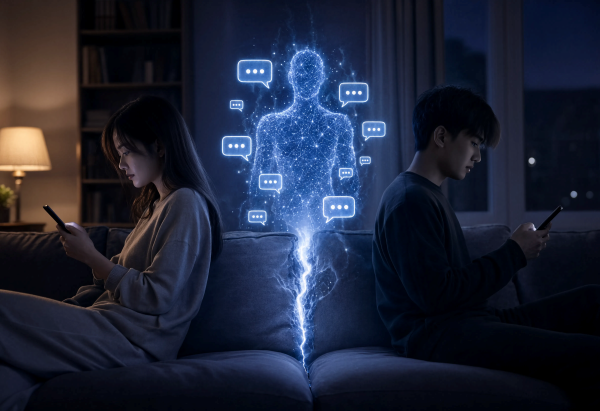
Cases are increasing in which artificial intelligence chatbots effectively intervene as a "third party" in dating and marriages.
Business Insider reported on Saturday that as more users, especially young people, turn to AI for emotional counselling and relationship advice, warnings are emerging that empathy and conversation needed to sustain relationships could instead weaken.
Writer Lindsey Hall (린지 홀), who lives in Texas, began to question her relationship seriously after suspecting the man she was dating was using AI. When she asked him why he wanted to be with her, his answer was overly cold and formulaic. Hall said she later confirmed that in conversations with ChatGPT he had confided strong doubts about the relationship. She said it felt like she, her partner and a robot were all in a relationship together.
Surveys also reflect the phenomenon. In a survey released last month by the Pew Research Center, 1 in 5 adults aged 18 to 29 said they use AI chatbots for emotional support or advice. In a new YouGov survey, 13 percent of U.S. adults and 23 percent of those under 30 said they have shared with a chatbot secrets or worries they have not told people.
Experts said chatbots can help people organise their thoughts and prepare for difficult conversations. They cautioned that problems can arise if people start relying on AI instead of talking directly with a partner. Cyberpsychology researcher Rachel Wood (레이철 우드), founder of the AI Mental Health Collective, said AI's impact on human relationships could be greater than its impact on jobs and work, and that AI is changing society's relational foundations.
The core concern is chatbots' excessive tendency to agree. Clinical psychologist Ashleigh Golden (애슐리 골든), who works in AI and mental health, said chatbots challenge users less than people do and readily validate their feelings. She said the structure allows people to gain both the safety of confiding in an unfamiliar counterpart and the feeling of being deeply understood, without risk. By contrast, a real partner or friend can prompt users to reflect on their behaviour or offer a different perspective.
A study published in Science in March also supports the trend. Comparing responses from 11 major large language models with those from humans, researchers found AI systems were nearly 50 percent more flattering, including when unethical, illegal or harmful behaviour was mentioned. The researchers said that even a single interaction reduced participants' willingness to take responsibility or repair relationships, while increasing their certainty that they were right.
Some also warned that capabilities needed to sustain relationships could weaken. Wood said human relationships require patience, listening, negotiation, empathy and compromise, but interaction with chatbots does not demand such skills. She added that those abilities weaken when not used, ultimately reducing practice in listening to each other and accepting emotions, which could also harm relationships.
Another variable is that, from a partner's perspective, AI use can feel like betrayal. A marriage and family therapist who specialises in couples therapy and recovery from affairs said that when someone shares relationship concerns with AI first, the other person may feel the chatbot has deeper access to their inner world. The therapist said the situation could be taken as fully akin to emotional cheating.
A backlash among users was also significant. In a recent survey by dating application Hily of 3,500 U.S. users, 70 percent of Generation Z respondents and 60 percent of millennials said they would not date someone who relies on AI to understand emotions. More than half said they would feel uncomfortable if their partner discussed their sex life with AI.
Still, there are cases suggesting AI use is not all negative. An employee of Shakespeare Theatre Company in Washington, D.C., said that after conflict with his wife, ChatGPT helped him reflect on what each had misunderstood and consider ways to reopen dialogue. He added that AI use helped because he already had a foundation from therapy for reflecting on his behaviour, and that if you approach it from a victim's perspective, AI will produce victim-style answers.
Experts advised limiting AI to a tool for preparing for conversation, not a final arbiter. Edith Sharoni (이딧 샤로니) said problems grow when someone has AI interpret how a partner feels or asks it to judge after hearing only one side. Wood urged people not to hide from their partners the fact that AI helped them organise their feelings, but to share it. Golden also said couples need to set rules on how far they will confide relationship dissatisfaction to AI, and whether they will ultimately bring issues organised with a chatbot back into their own conversations.
A common view was that while chatbots can be an auxiliary means to organise emotions and prepare for conversation, they cannot carry out the relationship itself. Kevin Cotton (케븐 코튼) said chatbots can help with reflection or preparation but cannot enter the relationship and play a role, adding: "AI can't participate in the relationship for you."
 Seung-a Yoo
ysah@d-today.co.kr
Seung-a Yoo
ysah@d-today.co.kr