
A new credit evaluation system for small business loan screening will begin operating from late August. It will assess future growth potential using data such as a business’s sales and trading area, employment and online usage information, in addition to the representative’s past financial history. The scope of application will also expand from 7 banks and 1.8 trillion won to 16 banks and 2.2 trillion won.
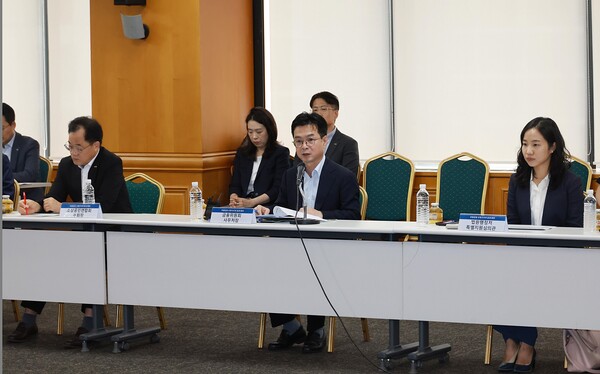
The Financial Services Commission said on July 27 it held a meeting of the Credit Infrastructure Subcommittee of the Inclusive Finance Strategy Task Force and the 7th task force meeting on revamping the credit evaluation system, chaired by Secretary General Shin Jin-chang (신진창), to review preparations to introduce the Small Business Customized Credit Evaluation System (SCB).
SCB combines a growth grade that assesses a small business’s future growth potential with the existing credit grade for individual business owners. It adds qualitative assessments such as workplace accessibility, trading area profitability and saturation, consumer trends, and certifications, business history and scale, to quantitative data including sales growth, business continuity, employment maintenance and online platform usage information. It also subdivides evaluation models by industry, including wholesale and retail, lodging and food, services and technology.
The Credit Information Service calculates the growth grade using relevant data, and credit evaluation companies for individual business owners combine it with the existing credit grade to provide SCB grades to banks. Small businesses with high growth grades can have their existing credit grades adjusted upward, raising the likelihood of loan approval and limits or allowing preferential interest rates.
The pilot operation will include Industrial Bank of Korea, Shinhan Bank, KB Kookmin Bank, Woori Bank, NongHyup Bank, Hana Bank and Jeju Bank, with K Bank, KakaoBank, Toss Bank, Suhyup Bank, iM Bank, Busan Bank, Kyongnam Bank, Gwangju Bank, Jeonbuk Bank additionally participating. The existing 7 banks will apply SCB from late August, while additional participating banks will apply SCB in stages during the second half of the year depending on their preparations.
SCB will also be used for a Saitdol loan dedicated to individual business owners scheduled to be launched in October. The dedicated Saitdol loan plans to raise the limit to 30 million won from 20 million won and expand annual supply to up to 150 billion won from 100 billion won.
Financial authorities are reviewing a plan to apply preferential interest rates to mid-credit individual business owners with high growth potential. From 2027, they plan to reflect SCB in guarantee screening by local credit guarantee foundations as well.
The FSC plans to finalise revisions in August to the Credit Information Business Supervisory Regulations and the banking sector’s guidelines for loan screening for individual business owner loans. It will also draw up operating guidelines covering procedures for interest rate and limit preferences for top SCB grades and immunity for employees who conduct reasonable evaluations.
Shin said, "Inclusive finance is not finance that turns away from risk, but finance that finds possibility," adding, "Finance must be changed in a direction that assesses future potential based on diverse data."
 Lee Ji-young
ljy@d-today.co.kr
Lee Ji-young
ljy@d-today.co.kr