
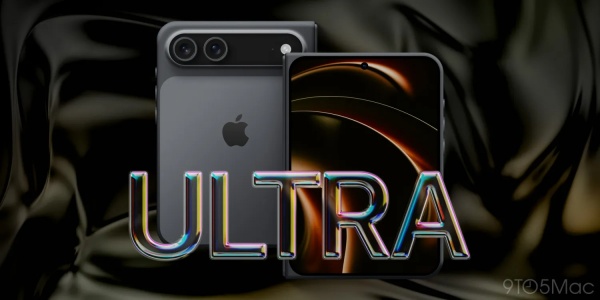
Apple may introduce its first foldable iPhone this autumn under the name "iPhone Ultra". The new product is expected to go beyond simply folding a screen and become Apple's top-end model, with features differentiated from existing iPhones across design, hardware and software.
On July 24, tech outlet 9to5Mac said Apple's first foldable iPhone is expected to try to differentiate itself from existing foldable phones by leading with six key changes.
The biggest change is the design. The iPhone Ultra is expected to adopt a book-style fold that opens left to right. The outer screen is expected to use a shorter and wider aspect ratio than existing iPhones, while the inner screen is expected to have a size and form closer to an iPad mini. It has also been suggested that it could use a display that minimises creases, seen as a weakness of foldable phones.
The display configuration is also expected to differ from existing iPhones. The outer screen is widely discussed at 5.3 to 5.5 inches, while the inner screen is discussed at 7.6 to 7.8 inches. Analysis says Apple is seeking to integrate the boundary between iPhone and iPad into a single device, as it can be used like a regular smartphone and then, when unfolded, offer a screen on the level of a small tablet.
Changes are also expected in the camera setup. The rear is expected to include a 48-megapixel wide-angle camera and a 48-megapixel ultra-wide camera, and there is a strong possibility that a telephoto camera will be excluded. Instead, considering the folding structure, the likely approach is to place one front camera on the outer screen and another on the inner screen.
Software is also expected to change to match the foldable form. The iPhone Ultra is likely to add some dedicated functions based on iOS 27. Expected examples include multitasking that runs two apps at the same time and app layouts optimised for a wider screen like the iPad. It has been reported that indications have already been spotted in iOS 27 that add landscape support for some apps.
Hardware is also expected to use the latest specifications. The iPhone Ultra, along with the iPhone 18 Pro, is likely to include the new A20 Pro chip and Apple's in-house C2 cellular modem. The A20 Pro is expected to improve performance and power efficiency by applying a 2-nanometre process and wafer-level multi-chip packaging, and it has also been discussed that 12GB RAM and LPDDR5-based memory will be included.
The biometric authentication method may instead become simpler than existing iPhones. The industry expects the iPhone Ultra to adopt Touch ID integrated into the power button instead of Face ID. This is because it is difficult to include Face ID modules in both screens in a foldable structure that reduces thickness, and the approach is expected to be similar to the method used in the iPad Air and iPad mini.
The price has not yet been finalised, but the prevailing outlook is that it will start at about $1,999 for the 256GB model. If realised, the iPhone Ultra would be the most expensive iPhone model ever. The industry expects Apple to try to justify the high price by emphasising that it is a new form of premium device that combines a smartphone and a tablet.
Even so, the product name and final specifications have not yet been officially confirmed. If an unveiling event this autumn discloses the actual name as well as foldable display quality, multitasking functions and whether Touch ID is adopted, Apple's foldable market strategy is expected to emerge more concretely.
 Jinju Hong
hongjj@d-today.co.kr
Jinju Hong
hongjj@d-today.co.kr