
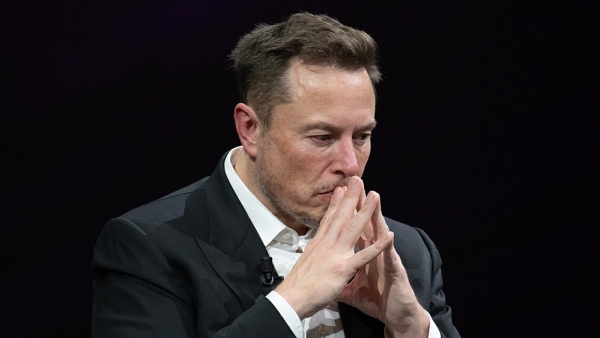
Elon Musk’s estimated net worth topped $1.3 trillion shortly after SpaceX’s listing, but shrank within weeks to $725 billion.
Cryptopolitan, a blockchain media outlet, reported on July 26 that the missing $600 billion was not a cash loss but the result of reduced valuation gains on Musk’s SpaceX stake after the stock fell.
The key factor was a sharp surge and slide right after SpaceX’s listing. SpaceX set its IPO price at $135 a share and began trading on June 12. The first trade was at $150 and the first-day close was $161. The stock rose to as high as $225.64 within 4 days. At that point SpaceX’s market value neared $3 trillion and the value of Musk’s stake also jumped.
The rise did not last long. In late July, the stock slid to around $113, about 16 percent below the IPO price. Musk wrote “(former) trillionaire” on social media on July 24, directly noting that the once-discussed trillionaire status did not last long.
The stock’s sharp swings were driven by an extremely small free float. SpaceX released about 4.9 percent of its 13.2 billion shares to the market at listing. That is very low compared with the roughly 80 percent free-float ratio typical of large listed companies included in major indexes, based on Nasdaq data. With few shares available, new buy orders drove the price sharply above the IPO level, and selling pressure later accelerated the decline.
SpaceX closed at $118.24 on July 23 and $115.07 on July 24. As of last Friday, its market value was about $1.5 trillion, down to nearly half from the June peak. Over 27 trading days after listing, the stock fell 23 percent from the first-day close of $161. Over the same period, the average return for 955 U.S. IPOs of $1 billion or more was 0.8 percent. Barron's, a Wall Street investment outlet, classified SpaceX among the bottom 10 percent performers among U.S. IPOs of $1 billion or more since July 2009.
Short sellers increased their profits during the decline. Ortex Technologies estimated unrealised gains for short sellers at about $15.5 billion. Short positions were tallied at 360 million shares, about 56 percent of the free float. Musk warned on social media that “companies that maintain large short positions in SpaceX for a long time will find it difficult to survive.”
Supply pressure is expected to persist. Early investors and employees can sell up to 911.5 million shares from Aug. 6, 2 days after SpaceX reports its first quarterly results after listing. That alone would lift the tradable share ratio from about 4.9 percent to around 12 percent. Additional shares are expected to enter the market in September, November and December as lockups expire. The possibility remains that Goldman Sachs may allow some investors to sell early. Musk’s own SpaceX stake is locked up until June 2027.
Musk’s wealth also depends heavily on the value of his Tesla stake, and Tesla shares also weakened during the same period. Tesla fell 18 percent in a week after its second-quarter results missed market expectations. Revenue was $28.2 billion and adjusted earnings per share were $0.33. The market estimate was $0.50 per share. Free cash flow also turned negative for the first time in 2 years.
Tesla invested funds in its robotaxi and its humanoid robot, Optimus, and a large plant for producing artificial intelligence chips. As a result, SpaceX’s stock decline and Tesla’s slide simultaneously pulled down Musk’s net worth. Because stake values are calculated using market prices, both the trillionaire mark created by SpaceX’s early post-listing surge and the $600 billion erased by the subsequent drop were close to book valuation changes.
(Former) Trillionaire
 Yoonseo Lee
yslee@d-today.co.kr
Yoonseo Lee
yslee@d-today.co.kr