
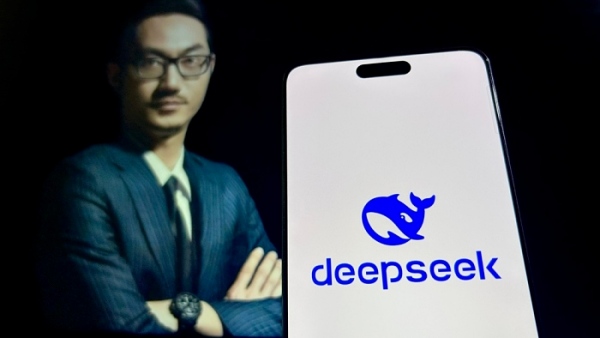
[DigitalToday reporter Jinju Hong] Chinese artificial intelligence (AI) company DeepSeek has temporarily halted procedures to raise a second round of funding. After private remarks by founder Liang Wenfeng (량원펑) spread outside the company, it reportedly notified some investors that it would not proceed with contract signings for the time being. Blockchain outlet Cryptopolitan reported the matter on July 25 local time.
DeepSeek recently told some potential investors it was suspending the signing schedule for a follow-on funding round. The decision came shortly after remarks attributed to Liang at a past investor meeting spread online. According to information confirmed by Bloomberg, Liang was said to have expressed strong displeasure that confidential information shared during investment talks had been leaked. Posts believed to be transcripts of the investor meeting spread on social media, but the authenticity of the content was not confirmed.
DeepSeek had entered a second fundraising round only weeks after completing a first raise in June. About $7 billion reportedly flowed into the institute at the time. In this follow-on round, DeepSeek pursued raising at least 10 billion yuan in new funds. Its pre-money valuation was said to have been set at at least 480 billion yuan. That is higher than the roughly $50 billion valuation assessed at the time of the first investment.
Tencent and Chinese battery company CATL took part in the earlier investment. DeepSeek began talks for additional investment immediately after the first deal ended, and some contracts were due to be signed within days. But the company verbally notified some investors of a schedule change. It was not confirmed whether the same guidance was delivered to all potential investors.
The fundraising has not completely fallen through. DeepSeek may resume talks later, reduce the round size, and proceed with a smaller number of investors. A new closing schedule has not been disclosed.
DeepSeek is also preparing for an initial public offering (IPO) alongside large-scale fundraising. There is also a view that the company could submit listing documents within this year. If a listing materialises, DeepSeek is likely to be in the spotlight as one of the representative AI companies entering the Chinese stock market.
The investment pause also intersected with debate over the Chinese AI industry's dependence on semiconductors. According to Chinese outlet Yicai, Liang was reported to have said China’s AI industry still needs Nvidia hardware and that its technology level lags the United States. The remarks amplified repercussions as the Chinese government presses for expanded use of domestically made semiconductors and lower reliance on Nvidia.
Chinese AI developers have long built systems around Nvidia's software ecosystem. This has raised issues that software compatibility and development efficiency drop when switching to Chinese AI accelerators.
U.S. export restrictions have limited supplies of Nvidia's high-performance semiconductors and pushed up prices, prompting China to accelerate efforts to foster its own semiconductor ecosystem. The Chinese government pursued a national project bringing together university researchers and semiconductor experts, and in 2024 it created a semiconductor industry fund worth about $48 billion.
Chinese companies have also moved to develop substitutes. Huawei is preparing its next-generation AI accelerator Ascend 950, and some early users evaluated it as showing higher-than-expected performance. Alibaba has also disclosed progress in developing its own AI processors.
Nvidia, meanwhile, has continued efforts to protect its China market. Nvidia Chief Executive Jensen Huang visited Beijing after the U.S. government allowed sales of the lower-spec H20 product to China.
The U.S. government has shown a position that it can keep China dependent on the U.S. technology ecosystem by ensuring it uses semiconductors with restricted performance rather than the latest products.
Chinese authorities later tightened regulation by calling in domestic technology companies to check whether they really need Nvidia's H200. Some companies were also reportedly required to pledge to buy Nvidia products only when necessary and to expand the use of Chinese processors. Orders shifted to Chinese semiconductor companies, but supply shortages also emerged as production capacity failed to keep up with demand.
Stricter U.S. enforcement and delays in shipments routed through the Middle East also pushed up unofficial prices for Nvidia graphics processing units (GPUs) in China. Local suppliers said prices for some smuggled GPUs more than doubled in six months. Even so, some Chinese companies are said to be pushing to build large-scale AI computing infrastructure using the latest Blackwell processors.
In the industry, some view DeepSeek's fundraising pause as not simply a schedule adjustment but a matter intertwined with management of confidential information, a reassessment of corporate valuation, IPO preparations and China's policy to reduce dependence on Nvidia.
Key points to watch will be how DeepSeek redesigns the structure of its investment round and when it will flesh out listing procedures. How a shift to Chinese AI semiconductors affects actual technological competitiveness and corporate valuation is also expected to remain a major variable.
 Jinju Hong
hongjj@d-today.co.kr
Jinju Hong
hongjj@d-today.co.kr