
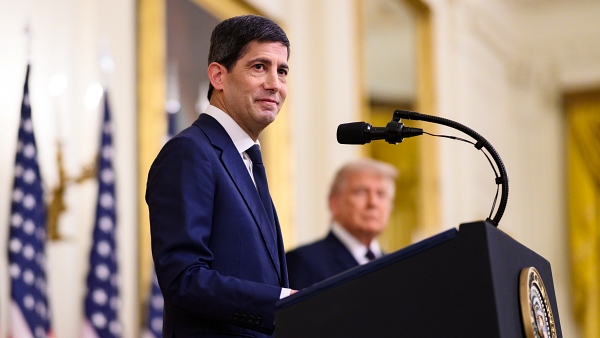
Federal Reserve Chair Kevin Warsh (케빈 워시) is being priced by markets as potentially raising the benchmark interest rate at this week’s monetary policy meeting.
On July 26 local time, blockchain outlet Cryptopolitan reported that renewed fighting between Iran and the United States pushed global oil prices above $100 a barrel, reviving concerns about energy-driven inflation.
The meeting begins on Tuesday and is the second since Warsh took office. Just a week ago, futures markets put the chance of a 0.25 percentage point increase at under 10 percent, but by Friday that probability rose to 36 percent. Investors now see at least 1 increase by September as effectively a done deal. They are also pricing in the possibility of 1 or 2 additional 0.25 percentage point increases over the next 9 months.
The shift in focus reflects a sharp jump in oil prices. Since the war began in late February, oil markets have shown wide volatility as Washington and Tehran traded barbs and pauses were repeated. Traders had viewed the inflation impact as temporary even if a closure of the Strait of Hormuz became reality. But that view weakened quickly once oil moved above $100.
Selling pressure then hit U.S. and European government bonds. Bond prices fell and yields rose. The U.S. 10-year Treasury yield climbed to its highest level in 18 months, and 10-year yields in Germany and France rose to their highest levels in about 15 years. Rising long-term yields are read as a sign that markets see greater persistence in inflation.
Recent U.S. economic data are also adding to the Fed’s dilemma. Weekly jobless claims released on July 24 fell to their lowest level since 1969, reaffirming labour market strength. June consumer inflation eased to 3.5 percent, but it remains far from the Fed’s 2 percent target. With growth holding up and layoffs limited, markets have been calculating that the Fed may find it hard to wait longer if oil prices also rise.
Warsh has opted not to provide advance signals about the direction of monetary policy. Appearing in Congress this month, he offered no specific hints tied to policy decisions while showing a stance of reducing the practice of signalling direction ahead of rate decisions. Warsh told lawmakers, "If we get policy right, and if we do, the inflation surge of the last five years will be a thing of the past."
He avoided giving a clear answer on which inflation indicators he weighs most or which economic data he trusts most. Instead, he tasked an internal task force with reviewing the issue. It is a different approach from the way the Fed has issued policy signals relatively actively over the past 20 years.
In Congress, questions continued over Warsh’s ambiguous stance. Democratic Representative Ritchie Torres of New York again raised that Warsh had spoken positively at his April confirmation hearing about an inflation gauge that excludes items with large monthly price swings. But Warsh drew a line, saying he has never backed a specific indicator. "None of them is a very good indicator of underlying inflation," he said, adding, "If I had a preferred indicator, I would not have created a task force and asked it to re-examine things from scratch."
Future communication methods are also not yet finalised. Warsh has not promised to continue the schedule of a press conference after every meeting that his predecessor, Jerome H. Powell, maintained. Powell has explained the economic assessment and the committee’s internal views after each meeting, but the Fed’s communications task force is reviewing the schedule itself.
Warsh also refused to provide guidance in advance when reporters last month asked about conditions for raising rates. "We cannot provide any forward guidance about what we will do next," he said, adding, "The good news is that the meeting is held in six weeks." He also said he wants every policy meeting to be not a place where conclusions are set before the meeting starts, but a 'family fight' of intense internal debate.
Against this backdrop, the key focus of this week’s meeting goes beyond the rate decision itself. With oil surging, employment holding firm and prices still high, the biggest point of attention is whether Warsh moves to a first increase or instead keeps his existing uncertain communication stance while adjusting market expectations.
 Jinju Hong
hongjj@d-today.co.kr
Jinju Hong
hongjj@d-today.co.kr