
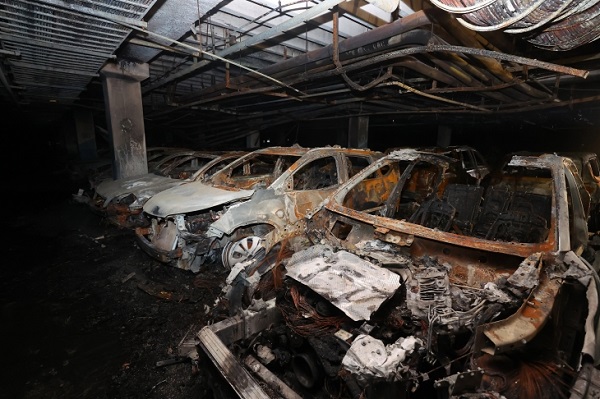
An "EV Fire Peace-of-Mind Insurance" scheme that compensates damage from electric-vehicle fires before the cause is identified has taken effect from July. Attention is focusing on a policy clause that specifies non-life insurers can seek recourse against parts makers such as battery manufacturers.
The clause defines where the burden goes for advance payments capped at 15 billion won per accident. If the cause is not determined, the insurer bears the cost. If a battery defect is confirmed, the bill goes to the cell manufacturer. How far the cause is established has become the standard that determines who bears costs that can run into tens of billions of won.
Under the fire peace-of-mind insurance terms of the Ministry of Climate, Energy and Environment, Article 7-1 says that after making advance compensation, insurers will seek recourse once the fire cause and negligence are confirmed. Targets include the owner or driver of the vehicle where the fire started, the manufacturer (including parts makers) or importer, the owner or manager of the charging facility, and other third parties legally liable for damages. Parts makers were documented as recourse targets.
The same terms exclude battery manufacturers from those eligible for compensation. Article 2 excludes from the insured parties the building management company and charging-facility manager, as well as the "manufacturer or importer of the covered electric vehicle (including parts makers)." Battery makers are also excluded from the premium burden. Of the 6.0 billion won in total annual premiums, the government supports 2.0 billion won and the remaining 4.0 billion won is shared by makers and importers selling models eligible for EV subsidies. As of July 15, 21 companies including Hyundai Motor, Kia, Tesla Korea and Mercedes-Benz Korea were participating. That means the entities paying and the entities that may face recourse are separated.
If a battery defect is proven, this insurance provision does not apply. Article 4, No. 19 says losses from fires caused by design defects, manufacturing defects or material defects in covered EVs are not compensated. The insurance operates when the cause is unknown, and when a defect is confirmed the matter moves into the product liability domain. The outcome of the cause investigation becomes the dividing point for who bears the burden.
Even if a defect is not proven, manufacturers can still face claims. That is because the 15 billion won limit does not mean full coverage. Article 8, Paragraph 5 says that if total losses from a single accident exceed the limit, payments are made to each victim in proportion to their losses. An example in the terms says that if total losses are 20 billion won, 75 percent of damages are compensated, and if losses are 50 billion won, only 30 percent is compensated. For an accident with 50 billion won in total losses, that implies 35 billion won remains outside the insurance coverage.
Victims must seek separate claims from the owner of the vehicle that ignited or the manufacturer for the uncovered portion. In major incidents where about 140 vehicles and a building are damaged, such as the 2024 Incheon Cheongna apartment underground parking lot fire, recourse within the insurance and damages outside the insurance proceed at the same time. Coverage is limited to fires that occur while parked or charging. Damage to the vehicle that ignited, fires directly caused by flooding, and cases where the direct cause is use of uncertified charging equipment are excluded.
BMS diagnostic capability draws attention as defence tool in recourse phase
This is a policy insurance programme to run for 3 years from 2026 to 2028. Once 3 years of accident data accumulates, the share of cause-unknown fires and the recourse success rate will become clear, and this is expected to be a standard for whether to extend the system and for calculating premiums from 2029. The key is who leads the interpretation of EV fire data. Because the side that secures cell-level abnormality records can prove or rebut defect claims, BMS diagnostic capability could function as a defence tool in the recourse phase beyond a safety technology.
The battery industry has built up battery management system, or BMS, capability in preparation for such proof disputes. LG Energy Solution said on the 21st it will expand its battery safety-diagnosis software business. The software pre-diagnoses defect types including voltage drops during charging, battery tab defects, micro internal short circuits, abnormal degradation and excessive lithium plating. The company said it holds more than 8,000 patents in the BMS field, and the software was developed based on empirical data from teardown analysis of more than 130,000 cells and more than 1,000 modules. It has already been applied to more than 100,000 EVs to secure a detection rate of more than 90 percent in safety diagnosis, and is being supplied to 9 global automakers.
The terms broadly define recourse targets as "manufacturers (including parts makers)" but do not set a sharing ratio between automakers and battery makers. That leaves room for the two sides to diverge over who holds diagnostic data and how much is disclosed. The industry views that once actual recourse cases emerge, responsibility allocation will inevitably be determined through individual supply contracts and litigation.
 Daegeon Seok
d2dg@d-today.co.kr
Daegeon Seok
d2dg@d-today.co.kr