
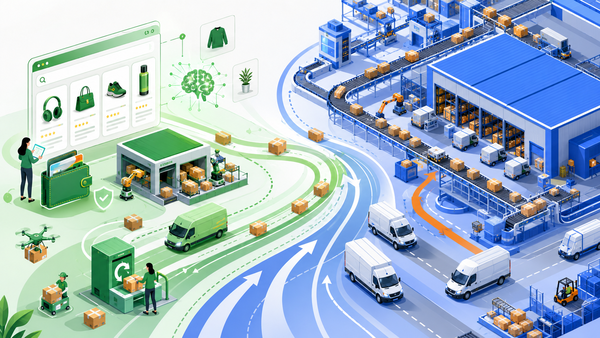
Naver is narrowing its gap with Coupang as it expands the scope of its commerce strategy beyond search and price comparison to include delivery operations.
According to an analysis of estimated average monthly payment amounts in the first half released by Wiseapp.Retail, Naver and Naver Pay scored 96.5 when Coupang’s payment volume is set at 100. It is the closest figure to Coupang among domestic retail platforms.
But the figure may also include Naver Pay payments at external merchants, making it difficult to read it directly as the gap in pure commerce transaction value with Coupang. It is more reasonable to view it as evidence that payment touchpoints have broadened that much.
Brokerage estimates point in a similar direction. Jeong Ho-yoon (정호윤), an analyst at Korea Investment & Securities, estimated Naver’s commerce revenue in the second quarter at 460.6 billion won, up 32.9 percent from a year earlier. Many brokerage analysts are also forecasting growth from the low to mid-30 percent range to as high as the upper 30 percent range.
User metrics are also rising. Naver Plus Store’s monthly active users reached 8.75 million in May, up 7.5 percent from the previous month, according to MobileIndex.
◆Beyond search and brokering, into delivery operations
Naver commerce started by helping users search for products and compare prices across multiple sellers. It later expanded payments through Smart Store and Naver Pay. More recently it has broadened its scope to include Naver Plus Store, membership and artificial intelligence recommendations, and now delivery and returns.
At the center of the shift is 'N Delivery by Naver (N Delivery FBN)'. Naver started an open beta service for the fulfillment solution from the 16th. Once sellers place products into a logistics center, Naver manages the operating process, including inventory management, exchanges and returns, and customer support, while logistics companies in the Naver Fulfillment Alliance handle actual storage and delivery.
For consumers, options have expanded beyond same-day and next-day delivery to include early morning delivery and Sunday delivery. An automatic pickup service for returned items will also be introduced from August.
Early effects are also emerging in how stronger delivery affects transactions and order frequency. Naver CEO Choi Soo-yeon (최수연) said on a first-quarter earnings conference call in April that the transaction value growth rate for sellers using N Delivery was 4 percentage points higher than for sellers that did not. She also said order frequency among members rose by more than 25 percent after membership delivery benefits were strengthened.
Naver also said transaction value on N Delivery rose 71 percent last year from a year earlier. Based on those results, Naver set a target of lifting the share of N Delivery to more than 25 percent of total orders this year, 35 percent next year, and more than 50 percent within three years.
Naver’s expansion into delivery and returns management is interpreted as aimed at reducing user churn. If search and AI recommendations connect users to products, delivery and returns experiences affect repeat purchases. Its involvement in inventory management and customer response can also be seen as an attempt to manage the post-purchase experience within the Naver ecosystem.
◆Chasing comes at a cost
But Naver has not chosen the same approach as Coupang. Coupang directly operates logistics centers and delivery staff nationwide to control delivery speed and quality. Naver, by contrast, has maintained an asset-light strategy that partners with logistics companies. It has recently been reported to be reviewing ways to secure logistics hubs in the Seoul metropolitan area, but Naver says it is not yet at a confirmed stage.
Behind Naver’s decision to maintain a partnership-focused logistics strategy are capital burdens and protecting profitability. If it were to pour trillion-won funding into a directly operated logistics network like Coupang, Naver’s operating profit margin could be damaged.
In fact, cost burdens are already rising. A compilation of brokerage estimates shows Naver’s operating expenses in the second quarter are expected to rise 16 to 18 percent from a year earlier. Commerce marketing costs and depreciation tied to investment in graphics processing units for servers are cited as key reasons. Brokerages accordingly see the second-quarter operating profit margin staying in the 16 percent range.
In addition, the impact of a Smart Store commission hike applied in June last year has already begun to be reflected in part from the second quarter, and the base effect disappears completely in the third quarter. That is why some are raising the possibility that commerce revenue growth itself could slow somewhat from the second half.
The gap in user scale is also still large. Coupang had 34.4 million monthly active users in May, nearly four times Naver Plus Store’s 8.75 million, based on MobileIndex. It means the loyal customer base built over years around Rocket Delivery is that solid.
Some assessments say the domestic e-commerce market is being reshaped around Coupang and Naver. If Coupang secured repeat purchase demand based on direct purchasing and its own logistics network, Naver is chasing by combining delivery services with search, AI recommendations and its seller ecosystem.
Naver’s next task is not limited to bringing payment indicators close to Coupang’s. It must prove that N Delivery and membership can drive repeat purchases even in the second half, when the effect of the commission hike disappears, and that increased transactions can offset higher delivery and marketing costs.
An industry official said Naver is boosting competitiveness by combining partner logistics with search, payments and its seller ecosystem, rather than owning a logistics network like Coupang. The official said whether expanding N Delivery leads to repeat purchases beyond a one-off promotional effect, and whether increased transactions can offset delivery and marketing costs, will determine the success of the chase.
 Hojeong Lee
lhj@d-today.co.kr
Hojeong Lee
lhj@d-today.co.kr