
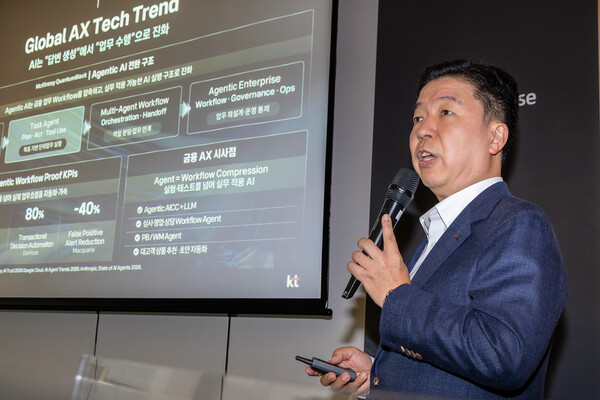
KT is consolidating its know-how to lower barriers to AI transformation, or AX, in the financial sector. It aims to accelerate AX in finance by supporting the full process from strategy to build and operations, based on finance-focused AI solutions and its data, cloud and consulting capabilities.
KT recently held a "financial AX strategy study" and introduced its business direction for financial-sector AX. It plans to embed AX that changes real work and management results, beyond simple proof-of-concept projects or the adoption of AI services itself.
As the era of agentic AI arrives beyond generative AI, the financial sector is also moving faster to apply AI to key tasks such as customer service, sales, screening and asset management. Changes in the institutional environment, including the enforcement of the Basic Act on AI, the preparation of AI guidelines for the financial sector and improvements to network separation regulations, also prompted KT to step up its financial-sector AX business. KT won more than 20 AX projects in the financial sector alone in the first half of this year amid those changes.
At the same time, challenges have grown to operate AI stably while meeting finance-specific regulatory requirements such as personal data protection, security, auditing and accountability. KT's assessment is that financial AX has also shifted into a business that must achieve both work innovation and stable operations.
◆ "Financial AX is measured by management results, not technology"
The key to financial AX projects is "execution results". Finance is a market where such AX results can be measured relatively specifically. That is because changes before and after AI adoption can be quantified, including call-handling time, product sales rates, customer conversion rates, screening processing time and operating costs.
Park Cheol-woo (박철우), head of financial business at KT's enterprise division, said financial-sector AX must be tied to management results. He said that is how it can build trust and confidence that AI contributes to work.
He also said what matters in financial AX is not which large language model was used or which technologies were applied. He said it must show how much value the project creates.
KT is pushing financial AX based on efforts to measure results as well as diverse technology stacks. It aims to expand the scope of AX to fit sector characteristics and focus on providing solutions suited to industry conditions.
In banking, it is standing out in agentic AI contact center, or AICC, projects that include AI chatbots and 상담봇. It is also pursuing the development of a group-wide integrated AI platform and AIDLC (AI Development Life Cycle), an AI-based development and operations system.
In insurance, it builds a generative AI-based "sales assistant" to support agents' consultations and product recommendations. AI analyses insurance products, policy terms and underwriting guidelines, and provides what is needed for consultations in real time. In the card sector, it built an integrated platform that allows LLMs to use data easily and an AI LLMOps system to deploy and operate AI stably.
KT's cooperation with Palantir, in particular, could be a good catalyst for the spread of financial-sector AX. KT provides pilot programmes, including free workshops, to reduce costs and technical burdens companies face in the early stages of adopting Palantir.
◆ Building a full-stack system... speeding AX with forward deployed engineers
KT is pursuing financial AX as an end-to-end business rather than selling individual solutions. It supports the entire process, from AX strategy and work design to system build, operations, internalisation, performance improvement and expansion to other tasks.
Kim Young-min (김영민), head of KT's AX engineering division, said of the industry's AX project process that PoC and pilot stages succeed but real expansion into work often gets blocked. He said it is because three factors are missing: data, governance and an operating model.
To address those limits, KT built a "five-layer AX full-stack" system that connects strategy and consulting, data, an AI platform, agents and operational governance. It is structured to jointly set AX strategy with customers, redesign work based on AI and data, run services in actual operations and continuously upgrade them.
It is also applying an FDE (Forward Deployed Engineer) approach in which AI specialists directly participate at customer sites. The company explained it will carry out AX projects by organically combining Data4AI, an integrated service that converts corporate data into AI assets, K-ontology, a knowledge model connecting work and data, along with agents and operational governance.
KT said it will continue to build an AX foundation that allows financial companies to keep using the data and knowledge assets they hold. It stressed it will ultimately raise business performance and productivity in the financial sector.
 Jin-ho Lee
jhlee26@d-today.co.kr
Jin-ho Lee
jhlee26@d-today.co.kr