
[DigitalToday reporter Oh Sang-yup] South Korean stocks this week are expected to seek direction while checking the U.S. Federal Open Market Committee (FOMC) and earnings from domestic semiconductor firms and U.S. Big Tech. With Middle East uncertainty and interest-rate burdens persisting, corporate earnings are expected to determine whether the market rebounds.
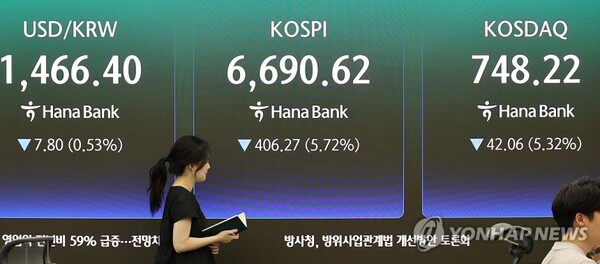
The KOSPI ended on July 24 down 406.27 points, or 5.72 percent, at 6,690.62 from the previous session. The Kosdaq index also finished down 42.06 points, or 5.32 percent, at 748.22. Investment sentiment froze quickly, with sell-side circuit breakers triggered in both markets that temporarily halted the effectiveness of program sell orders.
Until just before that, local stocks had tried to regain the 7,100 level on the KOSPI as bargain hunting flowed into semiconductors, which had seen big declines. Alphabet presented cloud results that beat market expectations and an expanded artificial intelligence (AI) capital spending plan, easing some concerns about a slowdown in AI investment.
But international oil prices and U.S. Treasury yields rose again as a U.S.-Iran military clash, Red Sea shipping uncertainty and tariff-related uncertainty resurfaced. Concerns that inflation pressure could rise again are seen as having led to risk-asset avoidance and foreign selling.
Even so, corporate profit forecasts were not significantly damaged. The KOSPI’s 12-month forward earnings per share (EPS) stood at 1,171 points as of July 23, higher than 1,105.1 points at end-June. On the same day, the forward price-to-earnings ratio (PER) remained near historic lows at 6.06. The index fell sharply, but earnings forecasts rose instead.
The industry sees external headwinds as potentially increasing short-term volatility, but expects market direction this week to ultimately be decided by corporate earnings. In particular, how semiconductors and Big Tech present future demand and investment plans is important.
SK Hynix’s second-quarter earnings, scheduled for July 29, are expected to show not only revenue and operating profit but also high-bandwidth memory (HBM) prices, long-term supply contracts, and memory demand and supply plans.
Recently, SK Hynix earnings forecasts rose rapidly and then were slightly adjusted. Investors are split on whether to see this as passing the peak in the semiconductor cycle or as a process of adjusting heightened market expectations.
If SK Hynix meets expectations and demand for HBM and server memory is confirmed to be solid, it could support a rebound in semiconductor shares. If profit-taking follows the release or guidance comes in below expectations, short-term volatility could widen again.
On July 30, Samsung Electronics will release final second-quarter results and performance by business division. Overall revenue and operating profit were confirmed through preliminary results, but details such as semiconductor profitability, memory prices and plans to expand HBM supply are expected to influence investor sentiment.
Over the same period, earnings releases from U.S. Big Tech will also draw focus. Microsoft and Meta are set to report early on July 30 Korea time, while Apple and Amazon are set to report early on July 31. The market is expected to focus more on AI-related capital expenditure (CAPEX) and future investment plans than on revenue and profit.
Earlier, Alphabet raised its 2026 capital spending outlook from $190 billion to up to $205 billion. That helped reduce some concerns about a slowdown in Big Tech’s AI infrastructure investment. But with free cash flow weakened by massive spending, it is also necessary to check whether AI investment is translating into actual revenue and profitability improvements.
If Microsoft, Meta and Amazon maintain or expand AI investment plans, earnings expectations for South Korea’s semiconductor, power equipment and data center-related shares could also rise. If they slow the pace of investment or show concerns about profitability versus investment, debate over whether semiconductor earnings have peaked could grow again.
Monetary policy is also a variable. The FOMC decision will be released early on July 30 Korea time. The market is leaning toward the likelihood of holding the policy rate, but there remains a chance the U.S. Federal Reserve takes a hawkish stance over the impact of rising oil prices and tariffs on inflation.
If additional tightening signals are limited, U.S. Treasury yields and the dollar could stabilize and also have a positive effect on foreign flows. If the possibility of future rate hikes is highlighted, volatility could rise, centered on growth stocks and the Kosdaq.
The sustainability of foreign flows also needs to be watched. In the recent rebound in local stocks, foreign buying also flowed into large semiconductor shares that had fallen sharply. If the exchange rate stabilizes and semiconductor earnings forecasts rise, foreign flows could lead a rebound in the index.
The Kosdaq continues to face a supply-demand vacuum, but could find a turning point if improvements to the single-stock leveraged exchange-traded fund (ETF) system are specified. If retail funds that had been concentrated in large semiconductors and related products become more diversified, rotation into Kosdaq growth stocks could also occur.
Still, assessments say investors should approach the market by checking earnings and flows rather than expecting an immediate sharp rebound. With Middle East uncertainty, tariff issues and monetary policy uncertainty still present, the index could move sharply depending on corporate earnings results.
Ultimately, the key this week will be whether the FOMC can ease rate jitters and whether domestic semiconductors and U.S. Big Tech can prove the sustainability of AI investment. If major companies’ earnings and investment plans meet market expectations, the KOSPI could recoup some of its losses. If concerns over rates and earnings rise at the same time, volatility is likely to persist.
Lee Kyung-min (이경민), a researcher at Daishin Securities, said, "With earnings momentum in the domestic stock market remaining valid, the direction is ultimately clear." He said, "Short-term volatility driven by domestic and external issues and events can be used as an opportunity to increase exposure."
Lee Jae-won (이재원), a researcher at Yuanta Securities, said, "The semiconductor sector has the most solid earnings momentum, but the decline is also excessive." He said, "It is necessary to respond with leaders centered on oversold semiconductors and then look at the possibility of rotation."
 Oh Sang-yup
yub@d-today.co.kr
Oh Sang-yup
yub@d-today.co.kr