
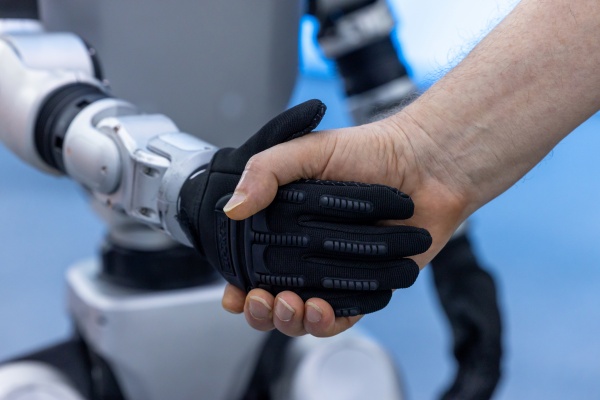
In China, adoption is rising quickly of artificial intelligence (AI)-based collaborative robots that work alongside people, known as AI cobots.
On July 24, the Hong Kong-based South China Morning Post (SCMP) reported that China’s robot industry is accelerating efforts to expand the cobot market beyond conventional industrial robots to machines that work in the same space as humans.
Unlike traditional industrial robots that only perform repetitive tasks inside fenced-off factory areas, cobots are designed to handle supporting tasks next to people. With AI functions added, they are evolving beyond repeating simple arm movements toward recognising environments and responding in line with work flows. Chinese companies see the shift as an opportunity to respond to manufacturing upgrades, labour cost burdens and demand for flexible production.
A key driver of the market shift is a broader range of applications. Cobots are expanding beyond production processes such as assembly, transfer and inspection into areas requiring interaction with people, including customer service, guidance and office assistance. The industry sees such equipment as a form that can be deployed faster on site than robots that fully replace humans. That is because they can share work space with people and are relatively easy to switch tasks, lowering the adoption barrier even for small and mid-sized manufacturers.
Chinese robot companies are positioning AI as the core of cobot competitiveness. As it becomes harder to differentiate with simple control software alone, visual recognition, voice interaction and autonomous decision-making have moved to the centre of product strategy. An industry official said cobots are no longer confined to being a "mechanical arm". They now need to develop toward understanding workers and collaborating with them.
Demand at worksites is also changing. Manufacturers want automation tools that can be deployed quickly rather than large-scale equipment replacement. Cobots are drawing attention because they can raise production efficiency while reducing installation footprint and operational burden. A company official said customers want a "system that helps people" rather than full unmanned operation. That means demand is strong to automate necessary processes first rather than overhaul the entire production line.
The trend also intersects with China’s industrial policy. China has continued to foster advanced manufacturing and the robot industry, and recently it has focused on combining AI with actual industrial sites. Cobots are cited as a field at that intersection. In factories where industrial robots are already widespread, more sophisticated collaboration functions are becoming a competitive point, while for companies where automation is less advanced, cobots can serve as a relatively low-burden first adoption tool.
Potential is also growing in services. Safety and recognition capabilities are important for moving at close distances to people. As a result, cobot competition appears to be shifting from hardware prices to software completeness, learning capabilities and real-world on-site adaptability. The industry says the contest will ultimately be decided by who can collaborate with people more naturally.
Behind Chinese companies’ focus on AI cobots is also the competitive landscape of the global robot market. As it is not easy to differentiate with industrial robots alone, a stronger movement is emerging to find new growth space in robots that collaborate with people. Companies see the ability to expand the market beyond manufacturing as an attractive factor.
Still, market expansion is not yet at a stage that directly leads to large-scale replacement. In actual adoption, issues such as safety standards, work accuracy, maintenance costs and on-site training must be verified together. A site official said cobots are closer to tools that raise productivity and flexibility than beings that "completely replace people".
Accordingly, a key point to watch going forward is how stably AI cobots can settle into a wider range of real tasks. China’s robot industry is shifting its centre of gravity from manufacturing-focused automation to intelligent robots that collaborate with people. Attention is on whether cobots will establish themselves as a main field leading China’s next-generation robot demand.
 Jinju Hong
hongjj@d-today.co.kr
Jinju Hong
hongjj@d-today.co.kr