
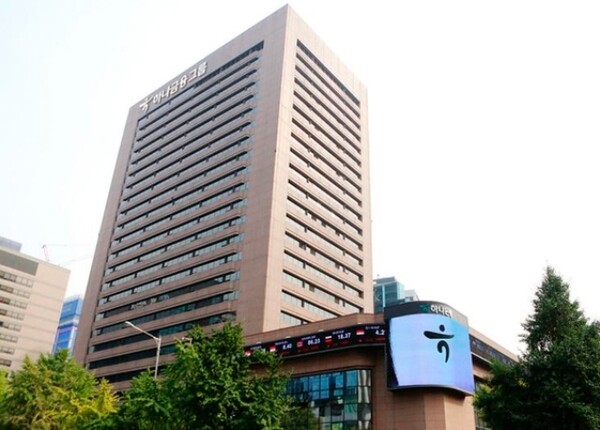
Hana Financial Group posted first-half net profit of about 2.4 trillion won this year, helped by higher fee income and a more diversified earnings portfolio. Large one-off costs hit results, including provisions related to corporate rehabilitation and translation losses from a rise in the exchange rate. Growth in wealth management, securities brokerage and investment banking (IB) helped defend earnings.
Hana Financial said on July 24 that first-half consolidated net profit rose 4.4 percent from a year earlier to 2.4029 trillion won. Second-quarter net profit was 1.1928 trillion won.
The first half reflected a 52.4 billion won drop in insurance profit and loss from the implementation of an advanced insurance actuarial assumptions plan, 74.9 billion won in provisions related to corporate rehabilitation, and 109.8 billion won in foreign-exchange translation losses from a rise in the exchange rate. Hana Financial said it maintained net profit growth despite those one-off costs, citing an expanded customer base, higher fee income and pre-emptive risk management.
First-half core profit rose 13 percent from a year earlier to 6.2956 trillion won, the sum of 4.8082 trillion won in net interest income and 1.4874 trillion won in fee income.
Fee income rose 37.7 percent from a year earlier, driving earnings growth. Asset management-related fees increased, including trust fees, securities brokerage fees and discretionary investment and management fees. Underwriting arrangement and advisory fees also increased as the group expanded its high-quality IB portfolio.
Hana Bank net profit 2.1211 trillion won
Hana Bank, its core unit, posted first-half consolidated net profit of 2.1211 trillion won, up 1.7 percent from a year earlier. Second-quarter net profit was 1.0169 trillion won.
Provisions tied to corporate rehabilitation applications and foreign-exchange losses from a rise in the exchange rate weighed on results. The bank's sales strength in core businesses, including wealth management, retirement pensions, trusts and foreign exchange, supported earnings.
Hana Bank's first-half core profit was 5.0788 trillion won, combining 4.4645 trillion won in net interest income and 614.3 billion won in fee income. Fee income rose 22.4 percent from a year earlier.
In the non-bank business, Hana Securities showed notable growth. Its first-half net profit rose 155.7 percent from a year earlier to 273.1 billion won. Higher brokerage fees from increased stock trading value and risk management against market volatility drove the improvement.
Hana Card and Hana Capital recorded net profit of 125.9 billion won and 104.5 billion won, respectively. Hana Life's net profit was 14.6 billion won.
Hana Financial's first-half credit cost rate was tallied at 0.29 percent. Despite the build-up of one-off provisions related to corporate rehabilitation applications, it was managed within the scope of the annual business plan.
As of end-June, the estimated common equity Tier 1 (CET1) ratio was 13.21 percent and the Bank for International Settlements (BIS) capital adequacy ratio was 15.26 percent. Return on equity (ROE) was 10.62 percent and return on assets (ROA) was 0.71 percent. Group total assets, including trust assets, were 936.527 trillion won.
ROE target raised to 12 percent
Hana Financial also announced on the day a strengthened 'Corporate Value Enhancement Plan 2.0'. The core goals are group ROE of 12 percent, a shareholder return ratio of at least 50 percent, and a CET1 ratio of at least 13 percent.
It raised its ROE target to 12 percent from its previous guidance of maintaining 10 percent or higher. It plans to lift profitability by strengthening the bank's core competitiveness, improving profitability at non-bank affiliates and pre-empting the digital asset ecosystem.
Hana Financial presented Hana Bank's equity investment in Dunamu as a mid- to long-term growth strategy linking existing financial infrastructure with the digital asset ecosystem. Hana Bank is the only commercial bank among Dunamu's strategic investors.
It set a shareholder return ratio target of at least 50 percent and will introduce a shareholder return framework linking ROE and the growth rate of risk-weighted assets (RWA). It also plans to increase total annual dividends by at least 10 percent each year until the dividend payout ratio reaches 40 percent.
It will manage the CET1 ratio at 13 percent or higher and use capital above 13 percent as funding for shareholder returns. It plans to pursue growth centered on capital efficiency by managing RWA growth at the level of nominal gross domestic product (GDP) growth.
Hana Financial's board decided to additionally buy back and cancel 250 billion won worth of treasury shares during the third quarter. It increased quarterly cash dividends to 1,155 won per share, up 26.5 percent from a year earlier.
 Ji-young Lee
ljy@d-today.co.kr
Ji-young Lee
ljy@d-today.co.kr