
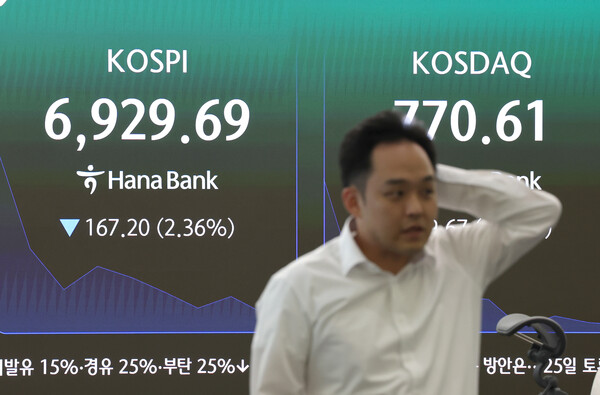
A sidecar was triggered in South Korea's stock market for the 10th consecutive day. After a selling sidecar was triggered on July 20, buying sidecars followed from July 21 to 23. On July 24, selling sidecars were triggered in both markets.
As of 1:13 p.m. on July 24, the KOSPI was at 6,682.30, down 414.59 points, or 5.84 percent, from the previous session.
In the main board market, retail investors were net buyers of 3.941 trillion won. Foreigners were net sellers of 2.573 trillion won and institutions were net sellers of 1.397 trillion won.
As losses deepened, a selling sidecar was triggered on the main board market at 11:23 a.m., temporarily halting program sell orders.
At the time, Mini KOSPI200 futures fell 5.04 percent to 1,070.80 from the reference price of 1,127.68. Program sell orders were suspended for 5 minutes.
This selling sidecar was the 21st on the main board market this year. Including buying sidecars, sidecars have been triggered 41 times this year.
This week, selling sidecars were triggered on the KOSPI and KOSDAQ on July 20, followed by buying sidecars on the KOSPI on July 21 and 22. A buying sidecar was triggered on the KOSDAQ on July 23, and both markets again saw selling sidecars on July 24.
Most of the top market-cap stocks were plunging. Samsung Electronics was trading at 248,500 won, down 21,500 won, or 7.96 percent, from the previous session.
SK Hynix was down 155,000 won, or 8.08 percent, at 1,764,000 won. SK Square was down 8.52 percent at 1,117,000 won.
Samsung Electro-Mechanics fell 8.22 percent, Hyundai Motor fell 8.68 percent, LG Energy Solution fell 5.75 percent, Samsung Life fell 5.61 percent and KB Financial fell 4.71 percent.
Samsung Biologics, meanwhile, was trading up 10.15 percent at 1,519,000 won, the only gainer among the top market-cap stocks.
The KOSDAQ was at 748.89, down 41.39 points, or 5.24 percent, from the previous session.
A selling sidecar was triggered on the KOSDAQ market at 11:47 a.m. At the time, KOSDAQ150 futures fell 6.09 percent to 1,273.30 from the previous close, and the KOSDAQ150 index fell 5.90 percent to 1,268.02.
Sidecars have been triggered 25 times on the KOSDAQ market this year, including 14 buying sidecars and 11 selling sidecars.
In Seoul's foreign exchange market, the won was trading at 1,463.40 per dollar, up 13.10 won from the previous session.
The sharp fall in South Korean shares was attributed to steep losses in major U.S. technology stocks such as Alphabet and Tesla in the previous session, along with gains in international oil prices and U.S. Treasury yields.
West Texas Intermediate rose 6.17 percent to $92.19 a barrel, and Brent crude climbed 7.04 percent to $100.69. The 10-year U.S. Treasury yield also rose to 4.693 percent.
Han Ji-young (한지영), a researcher at Kiwoom Securities, said, "South Korea's stock market is also facing downward pressure due to escalating geopolitical uncertainty between the United States and Iran and the fallout from a sharp decline in the U.S. stock market." Han added, "Still, the KOSPI's valuation burden is lower than in past periods of surging rates and expectations for semiconductor earnings remain, so the additional downside could be limited."
 Oh Sang-yup
yub@d-today.co.kr
Oh Sang-yup
yub@d-today.co.kr