
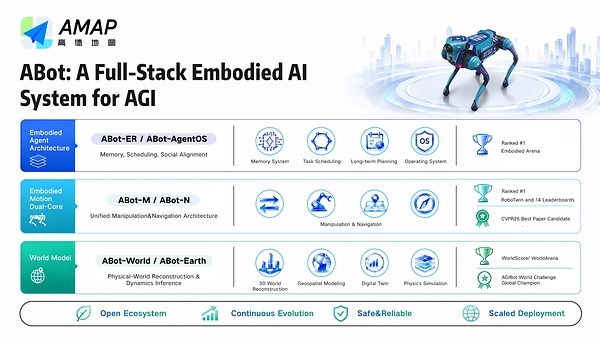
[DigitalToday reporter Jinju Hong] Alibaba Group Holding's mapping services unit Amap unveiled an upgraded version of its AI framework ABot that integrates robot mobility, manipulation, reasoning and control into a single system. Observers say China big tech companies are accelerating a shift in robot AI from competing on individual functions to competing on integrated systems.
According to the South China Morning Post on Wednesday, Amap described ABot as an integrated AI framework that connects a robot's "feet, hands, brain, central nervous system and motor nerves" into one system.
The announcement comes as competition intensifies over embodied AI, which applies AI in physical spaces to enable robots to move, understand their surroundings and perform tasks.
Amap said the industry has focused on improving individual functions such as mobility, manipulation and reasoning, but models have operated independently without sharing data. The company said it integrated five foundation models into one framework to address those limits.
ABot consists of five models: ABot-N1 for autonomous movement; ABot-M0.5 for movement and manipulation at the same time; ABot-ER for reasoning; ABot-AgentOS for system control; and ABot-C0 to execute actual robot actions. Each model is designed to collaborate as one system by taking roles corresponding to a robot's feet, hands, brain and nervous system.
ABot-N1 in particular was developed to perform city-scale autonomous navigation using only standard cameras and basic road-network information. Amap said the model recorded a 92.9 percent success rate in outdoor environments without a separate high-precision map.
ABot-M0.5 integrates mobility and manipulation so robots can pick up or manipulate objects while moving. ABot-ER and ABot-AgentOS handle task planning, reasoning and motion adaptation for different robot forms, while ABot-C0 converts AI decisions into actual movement.
Amap claimed ABot posted top-tier performance across 17 robot benchmarks worldwide, but it did not disclose specific evaluation items or comparison targets.
Competition among Chinese big tech companies in embodied AI is also intensifying. Tencent recently unveiled a full-stack embodied AI platform centered on its vision-language-action model Hy-Embodied at the World Artificial Intelligence Conference in Shanghai. Ant Group's robot AI unit Robovent also announced earlier this month Lingbot-Depth 2.0, a spatial perception model that more accurately recognizes glass, mirrors and transparent objects.
Amap has also recently expanded investment in embodied AI and is strengthening research into world models that simulate the real world to train robots.
In the industry, the ABot unveiling is seen as a signal that Alibaba has moved beyond simply adding robot functions and has begun competing in earnest to build robot AI platforms.
A key point to watch is whether ABot, which binds mobility, manipulation and reasoning into one system, can operate reliably in real industrial sites and service environments. As Chinese big tech companies shift the focus of embodied AI competition from individual model performance to integrated platforms, competition for leadership in robot AI is expected to intensify.
 Jinju Hong
hongjj@d-today.co.kr
Jinju Hong
hongjj@d-today.co.kr