
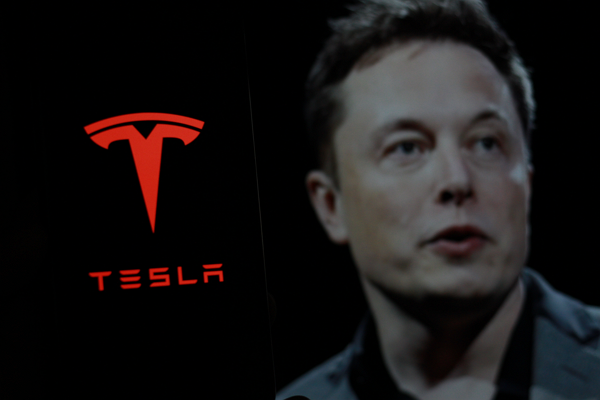
Tesla shares plunged more than 12 percent on fallout from weak second-quarter results, wiping out more than $140 billion in market value.
On July 23 local time, electric vehicle publication Electrek reported that Tesla’s share-price decline deepened after its 2026 second-quarter net profit and free cash flow fell short of market expectations.
This quarter, Tesla posted revenue of $28.24 billion, up 26 percent from a year earlier. Vehicle deliveries also hit a record 480,126. But the market focused more on weaker profitability. Operating profit fell 57 percent to $398 million, and the operating margin dropped to 1.4 percent from 4.1 percent a year earlier. Adjusted earnings per share came in at $0.33, below Wall Street’s estimate of about $0.53.
Cash flow also worsened. Tesla’s free cash flow turned negative at minus $1.09 billion. Capital expenditure jumped 142 percent to $5.79 billion over the same period. Regulatory credit revenue fell 67 percent to $146 million. The energy business reported a 41 percent rise in storage deployments to 13.5 gigawatt hours (GWh), but profitability declined.
Higher vehicle sales came with added costs. Tesla lifted sales volume by leaning on incentives such as low-interest financing support, putting pressure on automotive margins. It posted record deliveries, but that did not translate into improved profitability.
A conference call following the earnings release also failed to shift investor sentiment. Elon Musk (일론 머스크) said of the humanoid robot Optimus that "no humanoid robot today can perform general-purpose tasks without programming, but Optimus will be the first to do so." But this quarter’s results offered no evidence that Tesla is ahead of rivals in the field, and the timing of mass production remained unclear.
Robotaxi metrics were also far from market expectations. Tesla said it logged "more than 380,000 miles (about 610,000 km) of unsupervised driving" across 6 cities and that there were "no notable accidents." But paid robotaxi mileage stalled at about 900,000 miles (about 1,448,000 km) from the previous quarter, and the number of unsupervised vehicles actually in operation fell to about 21. The service area expanded to Orlando and Tampa, but criticism emerged that a map-based expansion is unlikely to prove growth potential when the total number of operating vehicles has not increased.
Musk also cited safety as a limiting factor for expanding autonomous driving. He referred to "the march of nines that comes from the long tail of edge cases" as a constraint on securing safety. Ultimately, the stock reaction appears to reflect that Tesla’s full self-driving narrative has yet to show clear progress in the scale and pace of real-world road services.
Tesla has positioned itself over the past 2 years as closer to an artificial intelligence company than an automaker. As a result, its corporate value has also been closely linked to expectations for robots and robotaxis. But in this earnings report, profit declines, weaker cash generation and a reduced scale of robotaxi operations stood out more than record vehicle sales. The market appears to be taking another look at current performance and execution metrics rather than Musk’s long-term vision.
 Seung-a Yoo
ysah@d-today.co.kr
Seung-a Yoo
ysah@d-today.co.kr