
[DigitalToday reporter Jin-ho Lee] A KAIST research team has developed an antibody that finds traces of cancer-causing mutations that are difficult to access with existing antibody treatments.
KAIST said on Thursday that a team led by professor Byeong-ha Oh (오병하) of the Department of Biological Sciences and researchers at Terazine, a protein design company founded by faculty, developed an antibody that selectively recognises only cancer cells with KRAS G12D, a representative cancer-causing mutation.
KRAS G12D is a form of the KRAS protein, which regulates cell growth and proliferation, in which a specific mutation has occurred. It is found in pancreatic, colorectal and lung cancers, but the protein is inside cells, making it difficult to directly target with existing antibody drugs.
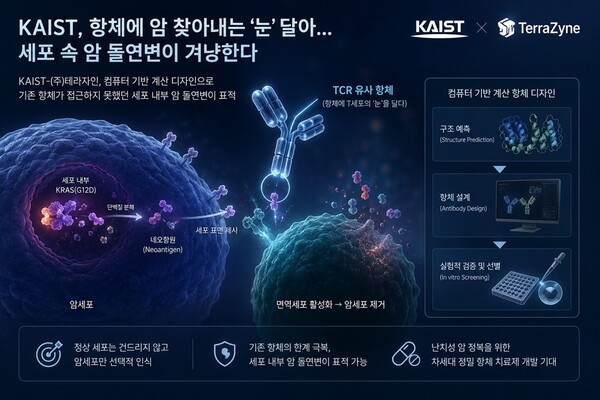
The team focused on the process in which cells break down aged or damaged proteins into small pieces. When the KRAS G12D protein inside cells is broken down, neoantigens, which are small protein fragments, are produced. Some of these move to the cell surface and are presented to immune cells.
The team combined computer-based computational protein design technology with an experimental screening process to design a T-cell receptor-like antibody that recognises only KRAS G12D mutant fragments presented on the cell surface.
T-cell receptors act as sensors by which T cells, immune cells, read protein fragments on the cell surface and detect cancer cells or virus-infected cells. The newly developed antibody was designed to give an antibody the eyes of a T cell so it can capture traces of intracellular mutations that existing antibodies could not directly access.
In experiments, the antibody showed little reaction to normal cells or other proteins and selectively recognised only cancer cells carrying the KRAS G12D mutation. Experiments applying it to immunotherapy also showed effective removal of cancer cells with the mutation. The team is currently verifying therapeutic efficacy in animal disease models.
Oh said the antibody developed this time selectively identifies only cancer cells with the KRAS G12D mutation, showing the possibility of developing precision antibody drugs that minimise damage to normal cells. He added that computational antibody design technology will be broadly used to develop next-generation antibody treatments targeting various cancer mutations.
The study included Terazine researcher Sang-pil Ahn (안상필) as first author. Oh and Terazine research institute head Bo-seong Jung (정보성) oversaw the research as co-corresponding authors. The findings were published online in the international journal Molecular Therapy on June 3.
 Jin-ho Lee
jhlee26@d-today.co.kr
Jin-ho Lee
jhlee26@d-today.co.kr