
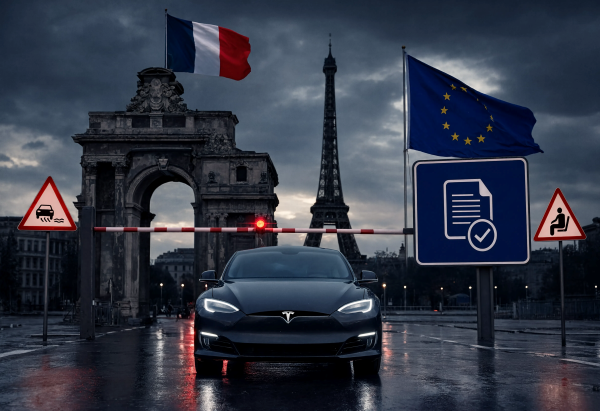
France has put on hold approval of Tesla's driver-supervised autonomous driving assistance feature Full Self-Driving (FSD).
On July 22, electric vehicle outlet Electrek reported that the French government said it would not allow FSD in its current state to be used on French roads, saying it permits speeding and does not sufficiently ensure driver attention in urban environments.
French Transport Minister Philippe Tabarot (필리프 타바로) said in a video statement that the answer was not yet when asked about the timing of approval for FSD in France. "The balance on safety is not yet sufficient to approve it in its current state," he said. He added that FSD "is not an autonomous driving system."
France cited two main issues. The first is allowing speeding. "We have confirmed that this system allows speeding," he said. The second is management of driver attention. French data suggest it is difficult to conclude that FSD keeps drivers' attention at an optimal level in complex urban driving situations such as lane changes, intersections and roundabouts.
The move is not a decision to reject Tesla's technology entirely. France's stance is closer to saying it will not automatically approve use on its roads based solely on nationwide approval in the Netherlands. Tesla received approval for supervised FSD functions in the Netherlands in April through the Dutch vehicle authority RDW, and has since expanded the scope of application by country. In June, Denmark became the fourth country to grant approval.
France says that rather than relying on an exceptional approval by one national regulator, it should first establish an approval system aligned with common European Union testing standards. France is continuing technical consultations with the Netherlands, other European countries and Tesla. A French transport ministry official visited the Netherlands last week to review related data, and said he plans to gather members of France's autonomous driving ecosystem this autumn to discuss the direction.
France also stressed it is supportive of the adoption of the technology itself. "France supports this kind of technology," he said. But he said it would not proceed "at the expense of road safety," making clear that reliable data and a verification system must come first.
Concerns raised in Europe are not limited to France. Sweden told the EU in June that it should reject FSD unless Tesla removes speeding behavior. European regulators have raised similar concerns since spring.
The speeding issue is also not a newly raised point by France. FSD has long allowed drivers to set the system above the speed limit, and criticism has recently emerged that speeding situations occurred after a related correction function was removed. Another burden cited is that Tesla has presented regulators with data on FSD safety that could be misleading. French authorities have already clashed with Tesla over this issue, and such precedents could work against Tesla in European regulatory discussions.
France's decision ultimately is less a measure to block FSD across Europe than a call for EU-level joint verification rather than country-by-country exceptional approvals. Whether Tesla can resolve the issue of allowing speeding and prove that its driver-supervision system works sufficiently in complex urban driving is emerging as a key variable in future approval discussions.
 Seungah Yoo
ysah@d-today.co.kr
Seungah Yoo
ysah@d-today.co.kr