
SK Telecom, KT and LG Uplus will work with the government to expand next-generation network investment to respond to the AI era. They will form a public-private consultative body to discuss network investment and improvements to telecoms regulation. They will also help stabilise livelihoods by easing the burden of communications costs and increasing partnership benefits.
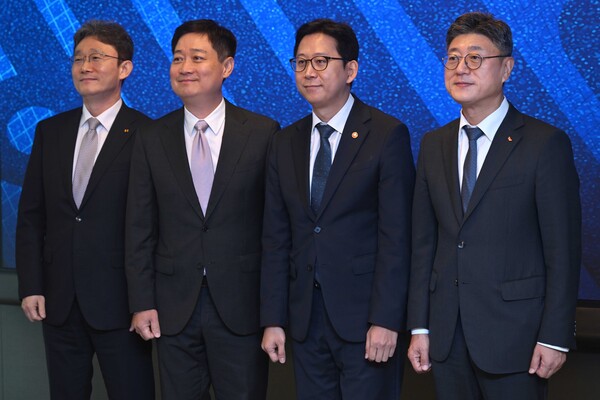
Deputy Prime Minister and Science and ICT Minister Baeh Kyung-hoon (배경훈) held a meeting with the CEOs of the three telecoms companies on July 23 at SKT’s headquarters in Seoul and discussed upgrading AI-based networks and measures to stabilise livelihoods.
Baeh Kyung-hoon, deputy prime minister: Telecoms must transform into 'AI companies'
In opening remarks, Baeh stressed that telecoms operators should move beyond being traditional network companies and transform into "AI infrastructure and platform companies". After the announcement of three mega projects, he asked them to join in expanding next-generation networks, a key element of national competitiveness, beyond AI data centres (AIDC) and physical AI.
"I will do my best to support the AI transition to prepare AI-based infrastructure and platforms and the overall telecommunications system," Baeh said.
The three telecoms companies on the day stressed their commitment to expanding next-generation network investment. SKT announced a future network evolution strategy including 6G and intelligent base stations (AI-RAN). SKT CEO Jung Jae-heon (정재헌) stressed, "As a company responsible for one axis of the three mega projects, we will fulfil our role and responsibility."
KT presented measures to expand subsea cable capacity, diversify landing stations and secure competitiveness in low-orbit satellite networks. KT, the first among the three to commercialise 5G standalone mode (SA), is accelerating efforts to build networks for the 6G and AI era.
Park Yoon-young (박윤영), CEO, said, "For surging global traffic demand, we will make a preemptive investment of about 1 trillion won in subsea cables to contribute to making South Korea an Asian AI hub." He added, "We will also secure control over satellite communications through satellite investment and realise an overwhelming gap in the AI era both on land and at sea."
He also reiterated a commitment to joining the three mega projects. Park said, "We will expand AIDC to a total scale of 1 GW based on actual demand and build AI edge infrastructure based on 3,500 central offices nationwide." He added, "Through the Physical AI Alliance, we will play a central role focused on demonstration projects and contribute to becoming the No. 1 physical AI power."
LG Uplus introduced plans to build 5G SA within this year and implement an AI-based autonomous network. It aims to develop the Paju AIDC into a reference for South Korea’s AI industry and use it as a foundation to enhance global competitiveness. LG Uplus CEO Hong Beom-sik (홍범식) said, "We will develop competitive AI models on top of infrastructure and build a sovereign AI ecosystem." He added, "We will also broaden cooperation with domestic AI semiconductor software companies."
Comprehensive package for institutional improvements via a public-private body
The Ministry of Science and ICT will run a public-private consultative body from August to comprehensively discuss network investment and telecoms regulatory improvements with the three telecoms companies. The ministry will involve private-sector experts along with its telecoms policy and AI policy departments to discuss a comprehensive policy package and announce the results within this year. It will also push ahead with 5G SA and AI demonstration projects in the defence and safety sectors.
Baeh and the CEOs of the three telecoms companies also reviewed the results of a previous meeting. The telecoms chiefs had discussed plan revisions including expanding a data reassurance option (QoS), expanding AI investment and other issues at a first meeting with Baeh in April.
The ministry explained that key agenda items are being steadily implemented. Plan revisions and priority transmission for emergency rescue communications have been introduced in phases since June. A chief information security officer (CISO) consultative body to strengthen security capabilities is also in operation.
The ministry will also work to build an institutional foundation to spread AIDC. Under the current system, AIDC is classified as a leasing business, making it difficult to receive support such as investment tax credits. The ministry will therefore review expanding eligibility for investment tax credits and will continue to create public-sector demand for AIDC. It will also seek to draft subordinate regulations under the AIDC law and introduce an exception to unify licensing and permit channels.
It will also review shutting down older-generation telecoms services such as 3G. The ministry said it will make decisions with service continuity and user protection as the top priorities.
The three telecoms companies will also step up their role in stabilising livelihoods. They will expand membership benefits and partnership discounts and provide temporary additional plan benefits for young people and vulnerable groups. Each company will announce detailed support measures within this month and roll them out in earnest in August and September. They also agreed to avoid encouraging sign-ups to high-priced plans and to continue improving wholesale rates for budget mobile operators.
Separately, Baeh and the CEOs of the three telecoms companies signalled in April, after their first meeting, that they would run a quarterly CEO consultative body. The aim is to restore public trust that has fallen due to repeated telecoms security incidents and to discuss information security, livelihoods and future investment tasks together.
"The government and the telecoms industry will work together to upgrade AI-based networks and strive so that every citizen can enjoy the benefits of communications, the internet and AI," Baeh said.
 Jin-ho Lee
jhlee26@d-today.co.kr
Jin-ho Lee
jhlee26@d-today.co.kr