
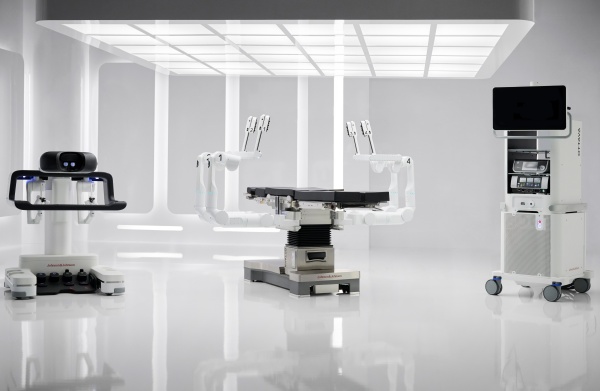
Johnson & Johnson has secured approval to sell its Ottava surgical robot in the United States, formally entering the robotic surgery market. Competition is expected to intensify in a U.S. market dominated by Intuitive Surgical's da Vinci system as Johnson & Johnson and Medtronic enter in succession.
Cryptopolitan, a blockchain media outlet, reported on Tuesday local time that the U.S. Food and Drug Administration granted marketing approval for the Ottava robotic surgery system through the De Novo process.
With the approval, Johnson & Johnson can use Ottava in 10 types of general surgery in the United States. The scope covers upper abdominal surgery, including gastrectomy, cholecystectomy and splenectomy.
The De Novo process is an approval pathway applied to new medical devices for which there is no existing device of the same type. Johnson & Johnson said this classification provides a foundation for Ottava to compete commercially in the U.S. surgical robot market.
Ottava is a soft-tissue surgical robot that combines an operating table and a robotic system into one. Johnson & Johnson described it as the world's first operating table-integrated soft-tissue surgical robot system. The company stressed that Ottava takes up 30 to 50 percent less installation space than existing boom-type or cart-type surgical robots. It said the system increases operating room space efficiency and reduces the burden of moving or positioning separate equipment.
Johnson & Johnson plans to begin a commercial launch first for a limited group of customers in the United States. It plans to improve the system based on feedback secured during the initial adoption process, then expand supply to other hospitals and overseas markets.
The approval is also expected to change the competitive landscape of the U.S. surgical robot market. The soft-tissue surgical robot market that Ottava is entering is an area effectively monopolised by Intuitive Surgical's da Vinci system.
Intuitive Surgical is a leading company that pioneered the robotic surgery market and has secured a large installed base in major hospitals. As of June, the number of da Vinci systems installed in hospitals worldwide was tallied at 11,395. Da Vinci has already been used in millions of surgeries, and 431 units were newly installed in the first quarter alone. Intuitive Surgical also posted results that exceeded market expectations in the second quarter of 2026. Revenue rose 18.5 percent from a year earlier to $2.89 billion.
Johnson & Johnson's market entry coincides with a recent trend of more new competitors in the U.S. surgical robot industry. The company submitted an application to the FDA for approval related to Ottava in early January. Earlier, Medtronic secured FDA approval in December last year for its Hugo robotic surgery system for urology procedures. It means large medical device companies capable of challenging da Vinci have emerged in succession in the U.S. market.
As a result, the U.S. surgical robot market is more likely to be reshaped into a three-way competition among Intuitive Surgical, Medtronic and Johnson & Johnson. It may not be easy, though, to catch up quickly with the hospital network, clinician proficiency and vast surgical data built by da Vinci. Ottava's actual competitiveness is expected to be determined by initial customer evaluations, the pace of hospital adoption and whether its range of surgical applications expands.
Johnson & Johnson plans to pursue system improvements and market expansion in parallel, starting with a limited launch in the United States. Attention is on whether Ottava can secure meaningful share in a da Vinci-centred surgical robot market.
 Jinju Hong
hongjj@d-today.co.kr
Jinju Hong
hongjj@d-today.co.kr