
SK Telecom said on July 23 that, at an International Telecommunication Union Telecommunication Standardization Sector (ITU-T) international standardisation meeting held in Geneva from July 14 to 22 local time, a new standardisation task related to a robot data production and utilisation framework it proposed was adopted.
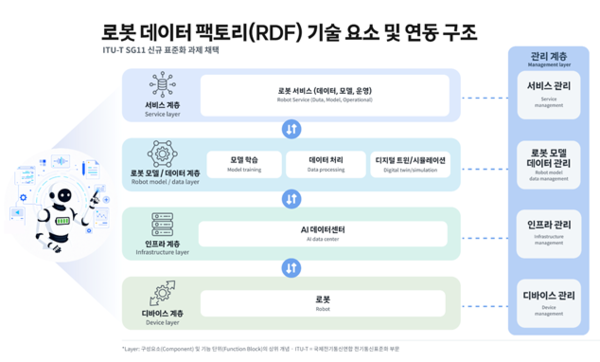
The adopted task covers the interworking structure and methods of a "Robot Data Factory (RDF)" to systematically produce and use data needed to train AI for intelligent robots such as humanoids.
Robot motion data is close to "practice problems" for training robot AI. For robots to become smarter, many good problems are needed. But the way this data is created and exchanged differs by robot model and installed software, making interoperability between different systems difficult.
As the robot industry has grown, demand has risen for large-scale, high-quality motion data needed for robot AI to learn to pick up and move objects and use tools. But because institutions and companies collect and manage data in different ways, it has been difficult to secure sufficient scale and consistent quality.
SKT proposed to ITU-T Study Group 11 (SG11) a new standardisation task that defines the roles of key functions that make up RDF, the interworking structure, and data exchange methods. The task was adopted as a new standardisation task at the July meeting after review and discussion by ITU-T members.
The task divides the RDF structure into 5 layers: service, robot model and data, infrastructure, device, and management. SKT plans to establish the roles of each layer and the interworking specifications between layers.
SKT said the standardisation task will strengthen the usefulness of its digital twin-based robot training platform, which it is preparing to launch in the second half. It aims to expand cooperation with robot and AI companies and research institutions in South Korea and abroad and contribute to activating the robot data ecosystem.
Choi Dong-hee (최동희), head of SKT's AI Strategy and Planning Office, said, "With the adoption of this new standardisation task, we have laid the groundwork to lead international standard discussions through capabilities accumulated in the physical AI field." He added, "We will continue to lead international standardisation in robotics based on technological competitiveness spanning robot training platforms and AI models."
 Jin-ho Lee
jhlee26@d-today.co.kr
Jin-ho Lee
jhlee26@d-today.co.kr