
[DigitalToday Seungah Yoo] Tesla has emphasised expanding its robotaxi service, but a quarterly breakdown of its own performance materials showed the growth trend stopped in the second quarter.
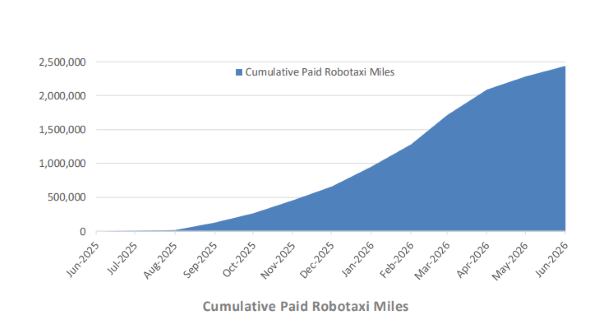
On July 22 (local time), electric vehicle outlet Electrek reported that Tesla’s 2026 second-quarter update put cumulative paid robotaxi mileage at more than 2.4 million miles (about 3.9 million km). But the quarterly increases were the same at about 900,000 miles (about 1.4 million km) in both the first and second quarters.
The key is the gap between a cumulative chart and actual quarterly growth rates. Cumulative indicators by design keep rising, making it easy for a business to look as if it is growing. But comparing cumulative figures at quarter-end changes the picture. Tesla’s increase in paid robotaxi mileage rose steadily from about 150,000 miles (about 240,000 km) in 2025’s third quarter to about 450,000 miles (about 700,000 km) in the fourth quarter and about 900,000 miles in 2026’s first quarter. In the second quarter it stayed at about 900,000 miles, the same as the first quarter, showing the increase stopped.
Tesla has recently put forward expanding service areas as a solution. On July 21, a day before its earnings release, it expanded robotaxi service areas to Tampa and Orlando. It did not disclose the number of vehicles deployed in each area.
The problem is that an increase in the number of cities on a map is not the same as an increase in actual operating scale. The number of active unsupervised vehicles across Austin, Dallas, Tampa and Orlando was put at about 21. In Austin, the fleet rose to about 25 by late April but recently fell to about 17. Splitting roughly the same 20-odd vehicles among multiple cities made the service area look wider, but it did not lead to higher vehicle throughput or increases in paid mileage.
The operating model is also far from a fully driverless service. Every robotaxi ride in California has a Tesla employee in the vehicle acting as a safety monitor. This has led to an assessment that the robotaxi is less a fleet of autonomously operating vehicles than a supervised test programme that collects fares.
Waymo, mentioned as a comparison, is running hundreds of thousands of paid driverless rides each week in multiple U.S. cities. It differs fundamentally from Tesla in that it is a true driverless service with no one in the front seat. Tesla’s cumulative 2.4 million miles also falls short of even a few weeks of Waymo’s operating volume.
In this situation, investors’ attention is turning to Tesla’s short-term guidance. Elon Musk (일론 머스크) failed to meet his short-term robotaxi targets in three consecutive earnings presentations. Shareholders asked why during this quarter’s question-and-answer session. An assessment has emerged that data does not support claims of “expansion” until growth in paid mileage steepens again.
The main point to watch is not simply expanding service areas, but the actual number of vehicles and the quarterly increase in paid mileage. If Tesla’s second-quarter increase remained the same as the first quarter even after raising the number of cities, a point has been raised that the next earnings presentation should confirm both an increase in vehicles and higher throughput.
 Seungah Yoo
ysah@d-today.co.kr
Seungah Yoo
ysah@d-today.co.kr