
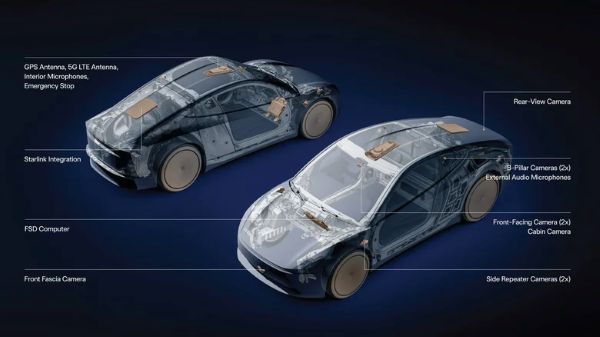
[DigitalToday intern reporter Seung-a Yoo (유승아)] Tesla has unveiled a design for its autonomous taxi, Cybercab, with an integrated Starlink V5 antenna.
On July 21 local time, IT outlet Engadget reported that Tesla posted a cross-section image of Cybercab on X, formerly Twitter, showing GPS antennas, 5G LTE and Starlink integrated together.
In a separate post, Tesla described Cybercab's communications setup as "space-based ultra-high-speed internet for the future of autonomous vehicles." The equipment being integrated is Starlink V5, announced last week. Starlink V5 is smaller and more power efficient than the previous model, but its speed is slightly lower at at least 375 Mbps, compared with more than 400 Mbps for V4.
A notable point is that Tesla has also included a 5G antenna. A small number of Cybercab vehicles currently in existence operate only in cities, and 5G networks are available in major U.S. cities, prompting a view that adding satellite internet on top may be excessive. Average 5G speeds in U.S. cities are about 175 Mbps, roughly half that of Starlink V5.
Still, Tesla's design appears to target overall vehicle operations rather than simply providing passenger internet. Satellite links can be used for vehicle-to-vehicle communications, navigation and remote support without relying on mobile signals. Starlink presents V5 as equipment focused on home internet, making it different in nature from "Starlink Mini," which is intended for use while moving. Even so, Tesla adopted it for in-vehicle integration.
The disclosure also highlights renewed business ties between two companies led by Elon Musk. Tesla appears to be seeking to expand its autonomous driving service network on its own by directly integrating SpaceX communications equipment into its vehicle platform. Redundancy between cellular and satellite networks can improve service continuity and stability in remote operations.
Tesla has not yet presented a timeline for commercialising Cybercab. Tesla has not said exactly when the new Cybercab will appear. Based on a robotaxi tracking site, Tesla has 39 unsupervised ride vehicles, while the total number in operation, including supervised vehicles, is 770.
As a result, the disclosure is closer to a signal showing how Tesla is designing communications infrastructure for its autonomous taxi than to an expansion of actual services. Points to watch will be how effective the built-in Starlink is for city-focused robotaxi operations, and how quickly Tesla can increase its fleet beyond a small-scale test phase.
Starlink V5 directly integrated in Cybercab pic.twitter.com/FxzTtzjB6I
 Seung-a Yoo
ysah@d-today.co.kr
Seung-a Yoo
ysah@d-today.co.kr