
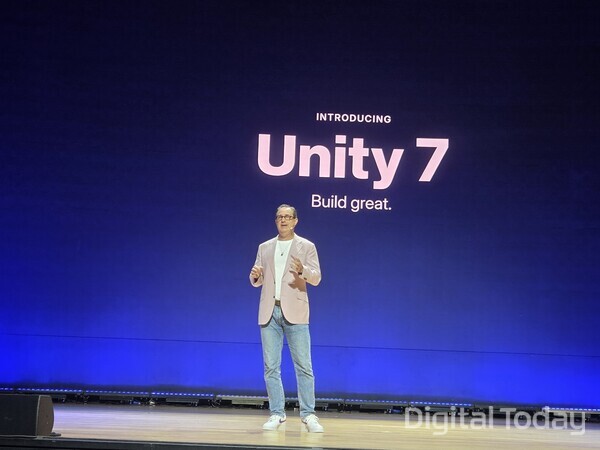
Unity unveiled its next-generation platform, 'Unity 7', which brings not only developers and artists but also artificial intelligence (AI) coding agents into the game production process. The core is to connect development tools with external AI and with distribution, advertising and payment functions, supporting everything from game creation to monetisation on a single platform.
Unity announced key features and its release plan for Unity 7 on Monday at its developer event, 'Unite Seoul 2026', held at COEX in Samseong-dong, Seoul. A Unity 7 preview will be released in December, with some features available earlier in beta. The full version is slated for release in the first quarter of 2027.
In a keynote, Unity President and CEO Matthew Bromberg (매튜 브롬버그) explained that Unity 7 was developed as game development shifts from developer-led work to a structure in which artists, producers and coding agents take part together.
Bromberg said, "A new point release is not enough." He said, "The way games are made has evolved. Now teams made up of different creators and coding agents are collaborating side by side across the entire production process. Unity must evolve accordingly."
◆Expanding collaboration beyond the editor... linking AI agents as well
The core of Unity 7 is not confining game production work to the Unity editor. Unlike the previous approach, where collaboration required access to the full editor, developers, artists and producers can validate assets and distribute builds from the programs they are most familiar with.
That is enabled by a command-line interface (CLI) and open application programming interfaces (APIs). These provide a path for each role to pull in only what is needed from their own work environment, and external AI coding tools can also connect to Unity projects through them to support writing and editing code.
Unity 7 will also include, for free, the model context protocol (MCP) that connects AI tools with Unity. This means developers can connect external coding agents they already use to Unity for code writing and editing, as well as project analysis. Unity also plans to integrate its own context-aware agent directly into the engine.
As AI starts being used not only for code generation but also for project analysis and edits across development, Unity has included coding agents in the platform's design. Its goal is to cut the time it takes for an idea to become a real game by allowing people and AI to check and edit assets, code, scenes and gameplay information together in real time.
◆Raising production speed and graphics quality at the same time
Unity 7 will modernise the engine core based on Microsoft's open-source .NET runtime, CoreCLR, to speed up development. It plans to apply 'dynamic reload', which reloads only what has changed, instead of reloading entire related areas even for small code changes, reducing waiting time and making play mode start almost immediately.
Unity plans to apply a 'fast play mode entry' feature by default for new projects starting with Unity 6.6. It explained that tests showed 'Load Nine' improved play mode entry speed by 2.7 times, an internal test sample by 4 times, and 'Deep Rock Galactic: Survivor' by 4.7 times. It also plans to gradually support cutting shader build time by up to 90 percent through platform-specific settings and fast build profiles.
A domestic example is 'Ember and Blade', introduced by Line Games director Jong-uk Kim (김종욱). Using adaptive probe volumes and a shader graph, it naturally implemented transitions between day, sunset and night. It also reduced rendering load (batch count) by more than 90 percent while displaying 400 monsters simultaneously using a VFX graph and vertex animation textures. With Addressables and profiling tools, it cut runtime memory usage by more than 75 percent.
The way light is handled will also change. Unity introduced a new real-time global illumination technology, 'Surface Cache GI'. Unlike previous methods that required precomputing lighting data such as lightmaps, it calculates indirect lighting in real time based on movements of light sources and objects, so lighting is immediately reflected in changes in time of day and in user-generated content. Unity demonstrated a scene using the technology running at 60 frames per second on a mobile device.
Unity also plans to introduce 'Unity Neural' technology in stages to reduce graphics processing load using AI. Neural upscaling and texture compression are the core, and in the demonstration it reduced texture memory use by more than 50 percent and related data volume by about 70 percent. It said processing is done directly on users' PCs, consoles and mobile devices rather than on servers, reducing execution delays without separate server communication.
◆From a tool for making games to a platform for running a game business
Unity 7 will expand beyond a tool for making games into a business platform that supports monetisation after launch.
First, a D2C (direct-to-consumer) feature that sells products directly to users, beyond app-market payments, will be integrated into Unity's in-app payment system. Developers can create web stores without coding and manage app and web products in a single catalogue, while users can buy through web payments without exiting the game. External payment firms such as Stripe and Coda will handle payments and fraud detection, with the aim of reducing fee burdens in app-market-centred payment structures.
At the user acquisition stage, the AI advertising platform 'Unity Vector' will be used. It learns usage and advertising data from Unity-based games to find users likely to enjoy the game and keep paying for a long time, and then shows ads. Unity said advertising spending through Vector more than doubled from a year earlier.
Park In-hoo (박인후), CEO of casual game company Actionfit, introduced as a domestic case, said, "Since its founding, Actionfit has achieved cumulative downloads of 40 million and global cumulative revenue of 100 billion won." He said, "Unity Ads has been a marketing partner since our early days, and recently we have been receiving help through a 'D28 ROAS' campaign, which measures revenue against ad spending over 28 days after launch, to improve in-app purchase performance and increase lifetime value (LTV) for the game 'Drop the Cat'."
In Unity 7, in-game purchase data can be sent directly to Vector to link advertising and payment data, analyse which ads brought in users who went on to make purchases, and re-optimise ad targeting.
Unity will also provide MCP that allows Unity Ads to be managed with prompts, making it possible to identify underperforming campaigns and reallocate budgets. A conversational AI agent, 'Campaign Assistant', which analyses the cause of issues and suggests improvements, will be released in an alpha version later this year.
Unity 7 inherits the Unity 6 architecture, allowing users to move existing code and assets without rebuilding projects or learning a new programming language. Unity is pre-testing compatibility for 68 major Asset Store packages to reduce conflicts with external assets during version transitions, and will also provide project analysis tools and a transition guide.
Bromberg said, "Game development is changing faster than at any time in history." He said, "The future will belong not to the biggest teams but to teams that can create unique content with new technology and secure players, and Unity 7 is the platform that meets the demands of this era."
 Ho-jung Lee
lhj@d-today.co.kr
Ho-jung Lee
lhj@d-today.co.kr