
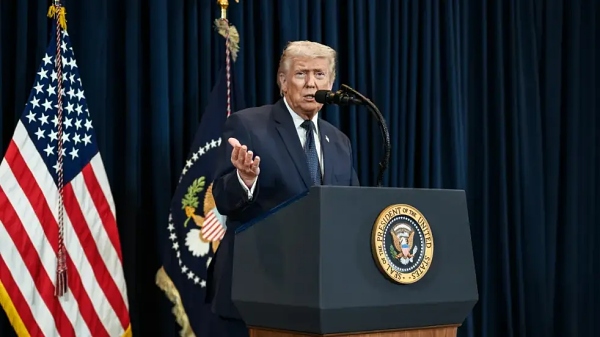
The Trump administration is reported to be considering steps to restrict U.S. companies from using Chinese open-source artificial intelligence (AI) models. As Chinese low-cost AI models rapidly improve in performance and price competitiveness, more U.S. companies are adopting them, prompting a response framed in terms of national security and industrial competitiveness.
On July 20, local time, blockchain outlet Cryptopolitan reported that the U.S. government is discussing multiple ways to block or restrict access to Chinese AI labs and open-source models.
A direct trigger cited is Kimi K3, recently released by China’s Moonshot AI. Kimi K3 was unveiled on July 18 to coincide with the World Artificial Intelligence Conference (WAIC) schedule in Shanghai.
Moonshot AI said Kimi K3 offers performance comparable to Anthropic’s Fable and OpenAI’s ChatGPT at a lower price. As more U.S. companies choose Chinese AI models to cut costs, analysis said Washington’s wariness has also grown.
Within the U.S. government, discussions have been reported since last year on adding Chinese AI labs to the Commerce Department’s Entity List. Inclusion on the Entity List makes it difficult for U.S. companies to trade with those companies or institutions, or access their technology, without government permission.
Around the same time, the U.S. National Security Agency (NSA) and the White House Office of the National Cyber Director issued guidance urging companies to be cautious about using Chinese AI labs. A draft executive order was also reported to have been discussed that would require U.S. companies hosting Chinese AI models on their own servers to guarantee security and accept responsibility for breach incidents. At the time, it did not proceed to implementation amid concerns that government regulation could hamper AI innovation.
More recently, there has been speculation that the mood inside the White House has shifted. After Sriram Krishnan (스리람 크리슈난), a White House adviser who was negative about government intervention, stepped down, the influence of figures calling for stronger national security has grown.
The approaches now being discussed are described as closer to indirect restrictions than an outright ban. Even without issuing a formal ban, the U.S. government is reported to believe it could achieve a similar effect by applying federal procurement rules, revisiting whether to place Chinese AI labs on the Entity List and publicly pressuring U.S. companies that use Chinese models.
Officials are also discussing ways to highlight the possibility of backdoors and security vulnerabilities in Chinese AI models. Another strategy is to encourage U.S. AI developers to strengthen their own open-source models to reduce reliance on Chinese models.
Critics have also raised concerns that such policies could work in favor of large U.S. AI companies. David Sacks (데이비드 색스), an external White House AI adviser, wrote on X, formerly Twitter, that AI policy is at a major inflection point.
He said closed AI labs that have effectively formed a duopoly based on model sales are trying to use government policy to eliminate open-source competitors. He argued regulation should not end up benefiting only the largest AI companies.
The speed of adoption of Chinese AI models is also visible in usage metrics. On OpenRouter, a platform that connects and provides multiple AI models, the share of routing token traffic handled by Chinese models was 46.4 percent. U.S. models accounted for 35.7 percent. As of July 2026, DeepSeek alone had a 17.6 percent share. A study released by Hugging Face in March also showed Chinese open-source AI models accounted for 41 percent of total open-source model downloads.
Companies are also continuing to adopt them. Startup Lindy has switched to DeepSeek V4 from an Anthropic model, and Airbnb and Siemens are reported to be testing AI systems from Alibaba and DeepSeek to cut costs.
Some analysis also says U.S. restrictions on AI exports to China have instead contributed to the spread of Chinese models. The argument is that after the United States restricted overseas exports of its most advanced AI models in early 2026, including Anthropic’s Claude Mythos 5 and Fable 5, Chinese and other countries’ models filled the gap.
Price competitiveness is also cited as a key driver of the spread of Chinese AI. It has been reported that companies in China can access computing resources at costs up to nearly 10 times cheaper than in the United States. Even if there are some quality gaps, assessments said the cost advantage gives companies sufficient incentive to choose Chinese models.
Valuation gaps are also large. OpenAI and Anthropic are pursuing initial public offerings this year based on valuations of about $852 billion and $965 billion, respectively. Moonshot AI, which developed Kimi K3, is cited at about $30 billion, and the company is reportedly considering an IPO within the next six months.
Ultimately, the U.S. government’s review of limits on Chinese open-source AI is seen as tied not only to security issues but also to the competitive landscape of the global AI market. Depending on what regulatory tools the U.S. government chooses, it is expected to affect U.S. companies’ choice of AI models, the standing of the open-source ecosystem and the pace at which Chinese AI companies expand in the U.S. market.
 Jinju Hong
hongjj@d-today.co.kr
Jinju Hong
hongjj@d-today.co.kr