
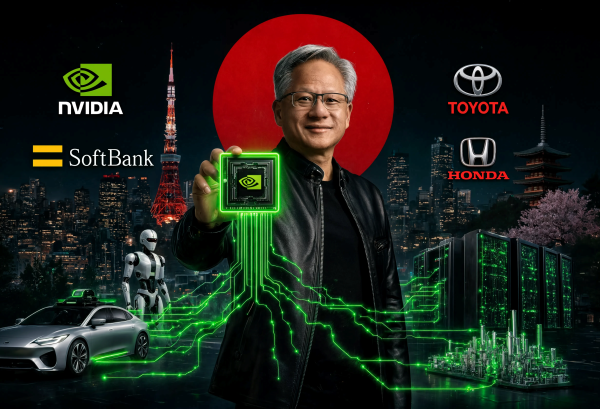
Nvidia has created a cooperation framework spanning national artificial intelligence (AI) infrastructure, robotics and automobiles by bringing together the Japanese government and key manufacturing companies.
On July 19 local time, IT outlet TechCrunch reported that Nvidia CEO Jensen Huang (젠슨 황) visited Tokyo on July 15 to 16 and confirmed multiple projects linked to Japan’s physical AI strategy.
A key point of the visit was that Japan’s push to build a homegrown AI system aligns with Nvidia’s next-generation chip supply strategy. Under a plan not to leave factory and robot operations entirely to U.S. or Chinese AI, Japan is bringing together about 44 domestic companies to 추진 a state-backed AI development company, Noetra. SoftBank, Sony, NEC and Honda are taking central roles, and the Japanese government plans to invest up to 1 trillion yen over five years.
Noetra will develop a homegrown foundation model for use in robots, vehicles and factory sites. Nvidia will supply the core infrastructure to train it. Nvidia plans to build a next-generation chip-based Vera Rubin AI Factory, targeting operations in 2028. The facility will be equipped with 13,750 Vera central processing units and 27,500 Rubin graphics processing units, and power capacity was presented as 140 megawatts. Nvidia calls the facility the world’s first national AI infrastructure.
A development timeline for Noetra was also presented. In fiscal 2026, it will release an inference model with enhanced Japanese-language capabilities. In 2028, it will expand to an omnimodal model handling text, images, video and audio. In 2030, it plans to progressively open a real-world native AI focused on robot operation to external developers.
In robotics, major Japanese manufacturers are rapidly coalescing around Nvidia. Fanuc, Yaskawa Electric, Kawasaki Heavy Industries, Fujitsu, Hitachi, NEC, Sony, SoftBank, Kubota and robotics group AIRoA decided to pursue development based on Nvidia’s Cosmos model. Nvidia unveiled Cosmos 3 Edge in Tokyo, running on an internal Jetson Thor chip, broadening the scope of on-site applications.
Some companies are already testing a joint control system. Honda R&D and Omron have begun development using related tools. In an Nvidia statement, Huang said, "The next frontier of AI is in the physical world," and called it "a once-in-a-generation opportunity for Japan." He added, "Japan invented modern manufacturing," and "now it has the opportunity to redesign it for the era of intelligent industry."
Cooperation with Toyota has also widened. Toyota already uses Nvidia chips across its vehicle technology and previously said at CES in January 2025 it would apply the Nvidia Drive platform to next-generation vehicles. The cooperation has expanded beyond in-vehicle software to include simulation for production line design and road traffic recognition systems. Toyota vehicles will adopt advanced driver assistance systems that support steering and braking but require driver intervention.
These moves also align with the Japanese government’s industrial strategy. To respond to a shrinking workforce, Japan set a goal of deploying 10,000,000 AI-equipped robots across 18 fields by 2040. To that end, it is pursuing physical AI investment totaling $65 billion across the public and private sectors. In its AI robotics strategy unveiled in March, it also presented a goal of securing more than 30 percent of the global AI robotics market by 2040. The Japanese government sees that market at about 20 trillion yen.
In this 흐름, Japan’s strategy is tied not only to industrial development but also to technological self-reliance. With the United States and China leading large-scale AI competition, Japan is seeking to reduce external dependence by securing domestic data and domestic computing infrastructure. At a physical AI launch event held by the Japanese government on July 16, Economy, Trade and Industry Minister Ryosei Akazawa (아카자와 료세이) attended alongside him, and Prime Minister Sanae Takaichi (사나에 다카이치) participated by video. The Takaichi administration has placed AI and semiconductors at the core of its growth strategy and announced a plan to attract combined public and private investment of 370 trillion yen by 2040.
Still, it has become clear that Japan’s independent strategy is, for now, based on Nvidia chips. Japan is aiming for leadership in physical AI using factory-site data and its manufacturing base, but a U.S. semiconductor company remains at the center of large-scale model training and infrastructure construction. Huang’s Tokyo schedule is described as a move that tied Japan’s robots, supply chains and demand for next-generation chips into one axis.
Explore the full recap of NVIDIA’s week in Japan. https://t.co/JhZMQ6FSNq
 Seung-a Yoo
ysah@d-today.co.kr
Seung-a Yoo
ysah@d-today.co.kr