
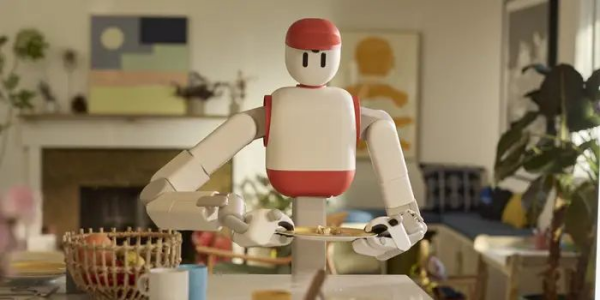
A home-robot artificial intelligence model that can fold unfamiliar clothes on its own in unfamiliar homes has been unveiled. As the ability to adapt to different layouts and objects in each home has been seen as the biggest hurdle to commercialisation, expectations are rising that competition in home robots could be brought forward after it showed a high success rate in real living environments.
On July 16 local time, Business Insider reported that U.S. startup Sunday Robotics announced a new AI model, ACT-2, that powers its wheeled home robot Memo.
The company said Memo succeeded in folding laundry with a success rate of more than 99 percent in tests involving unfamiliar home environments and clothing it had not learned. Unlike existing robots optimised for specific spaces or objects, the key is that it is designed to transfer task skills learned in one environment to a new environment.
The home-robot industry has long seen generalisation — adapting to different layouts and objects in each home — as the biggest challenge for commercialisation. Even if performance is high in controlled labs, performance often drops sharply in real homes when the environment changes.
Tony Zhao (토니 자오), Sunday Robotics' chief executive officer, said, "2026 will be the year when commercialisation of autonomous home robots is brought forward significantly thanks to this breakthrough." He added, "Memo's performance shown in the office was reproduced almost 그대로 in real homes."
The announcement also comes as competition in the home-robot market ramps up. Y Combinator-backed startup Weave Robotics plans to ship its $7,999 wheeled robot Isaac 1 with a laundry-folding function in California this fall. 1X is preparing to supply its roughly $20,000 humanoid Neo, and Tesla is also pushing to distribute its humanoid robot Optimus to homes. Sunday Robotics also plans to start a beta programme this fall to deploy Memo in ordinary households.
Sunday Robotics also proposed SOLVE as a standard for evaluating robot performance. It aims to assess how stably robots carry out tasks in real environments rather than relying on flashy demonstration videos.
The company said companies should also disclose the tasks a robot can perform, the test environment, how much additional learning is needed in new environments and whether human intervention is required. Sunday Robotics presented Memo's laundry folding as the first SOLVE case.
ACT-2 uses a two-stage training method. First, a person wears the company's in-house sensor gloves and performs everyday tasks, allowing the robot to learn basic manipulation skills. The gloves, which cost about $200 to make, are designed to match Memo's hand structure so human movements can be transmitted naturally into robot actions.
After that, the robot improves performance through repeated trial and error in its own operating system. Sunday Robotics explained that a robot with basic knowledge can learn new tasks within minutes and improve performance.
The company has tested Memo over the past several months in various environments including employees' homes and Airbnb properties to verify its ability to cope with unfamiliar spaces. Memo is expected to operate autonomously under normal conditions, with remote operators intervening only when users request help. This is similar to remote support systems for self-driving cars.
The company stressed, however, that it will not collect data from customers' homes during remote intervention or use it for additional learning. Zhao said, "Full autonomy is the best way to earn user trust," adding, "We will not use a method of collecting data inside the home through remote operation to improve the model."
Sunday Robotics raised $165 million earlier this year at a valuation of $1.15 billion. Founded in a Silicon Valley hacker house in 2024, the company now has more than 100 employees.
Memo has previously demonstrated various household tasks including clearing a dining table, loading a dishwasher and pulling espresso shots. The company said its goal is to raise the reliability of these functions through ACT-2. It added that it is currently learning tasks such as using a vacuum cleaner, putting away toys, zipping up and making coffee, but has not yet reached commercial-grade stability.
 Jinju Hong
hongjj@d-today.co.kr
Jinju Hong
hongjj@d-today.co.kr